When it comes to hate crimes, no group in Canada is more heavily targeted than Jews. In an innovative and strategic push for change, 25-year old Jordana Lebowitz has founded ShadowLight, a not-for-profit Holocaust education centre set within…a cattle car.
“We want to help people connect to the survivor stories while being immersed in this historical space,” explains Lebowitz of the unique setting for her effort.
“The Cattle Car: Stepping in and Out of Darkness” was launched Oct. 18 at the Toronto Railway Museum. It is an interactive, multimedia installation within an exact replica of a Second World War-era cattle car that was used to transport Jews and other targeted groups to concentration and extermination camps.
At the Oct. 18 launch of the cattle car exhibit: Jordana Lebowitz, founder of ShadowLight, and Michael Levitt president and CEO, Friends of Simon Wiesenthal Center. (Photo by ShadowLight)
As the installation’s name suggests, the windowless wooden freight cars were originally intended to transport cattle. At least 150 unfortunates were crammed into each car, without food, water, washroom facilities, or the ability to sit down. Many perished en route to death mills. Historians have suggested that without the mass transportation carried out on Europe’s railways in these box cars, the scale of the Final Solution would have been much different.
As Holocaust survivors diminish in number, ShadowLight’s installation inspires future generations to take action against injustices around them, say Friends of Simon Wiesenthal Center (FSWC), which has partnered with ShadowLight to advance Holocaust education in Canada.
“Holocaust education is the key tool in the fight against and prevention of antisemitism and hate that we are sadly seeing rear its ugly head all too often around the world,” said Michael Levitt, FSWC president and CEO. “Our goal is to work together with Jordana and ShadowLight to create course material for students and make this an even fuller experience on campuses.”
The cattle car museum on wheels will visit school campuses throughout Canada.
Lebowitz’s passion project was born when she was a 16-year old CHAT student taking part in the March of the Living.
She was in the one-time Nazi death camp of Majdanek when she saw a megillah scroll in a glass box, “and that made me sad, yet I realized the story doesn’t end here in a massive pile of ashes,” Lebowitz recalled.
That wisdom planted the seed. She searched for months for a cattle car. Finally, in 2015 as a second-year student at University of Guelph, and with help from Hillel, she brought the cattle car to campus. It has since been displayed every year at the University of Guelph for Holocaust Education Week.
“Jordana drove the whole concept with her student leaders. It was the first incarnation of her program ShadowLight,” said Marc Newburgh, CEO of Hillel Ontario. “FSWC has the ability to take this out in the community and amplify it.”
As a co-op student, Lebowitz worked at the Museum of Tolerance in Los Angeles, the Jewish Holocaust Center in Melbourne, Australia, and the Raoul Wallenberg Centre for Human Rights.
Lebowitz revisited the cattle car initiative with a renewed determination to bring the powerful educational tool to other school campuses. ShadowLight was incorporated in 2018, with a team of 20 young volunteers and 20 advisors.
“We brought Holocaust survivors Hedy Bohm and Nate Leipciger into a green screen studio and filmed their stories,” said Lebowitz.
Actors then brought their stories to life. “The walls fill up with people to visualize how many would have been squished in this space,” Leibowitz explained. “There are 100 hand-painted footprints on the ground to show how closely family groupings were.”
Lebowitz, who’s pursuing her masters in education remotely from the University of Southern California, marvels about her creation. “I never thought that ShadowLight would come to life,” she said.
The cattle car exhibit runs about 30 minutes and is recommended for students Grade 8 and above. The second public showing will take place on Nov. 15 and 16 at Wychwood Barns Park in Toronto’s St. Clair Ave. W. and Christie Street area. Strict COVID safety measures are in effect.
As Canadian Jews mark Remembrance Day today, one of the names of the fallen they might see on war cenotaphs across the country is that of Flying Officer Harry Uretzky.
His family and friends knew what a gifted writer the young Edmonton man was. Now, for Remembrance Day, Uretzky’s niece, Karen Hering, has released her late uncle’s war diary with a collection of his poetry. Hering and her siblings decided to publicize Harry’s story as part of their journey to learn more about the uncle they never knew.
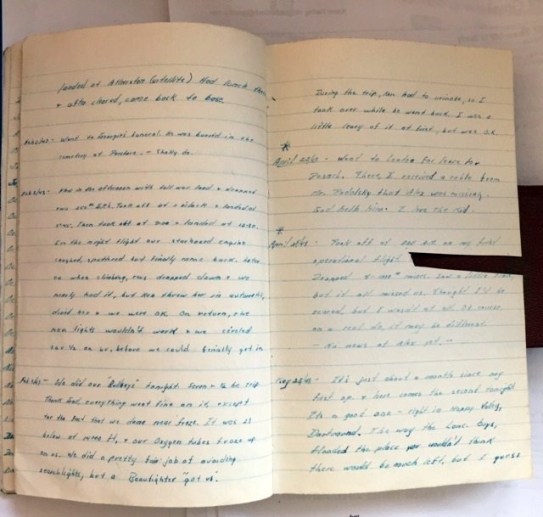
Harry Uretzky‘s diary; page 9-10 Feb-May 1943
“It was a very sensitive, traumatic topic with my grandmother, and therefore my father (Abe, Harry’s older brother) so Harry was rarely spoken of,” Hering said in a recent email. “It was only after my grandmother passed away that we found the small box of artifacts about my uncle and we became more interested in his story. By then, my parents had long been dead and just about anyone else who might have known him.”
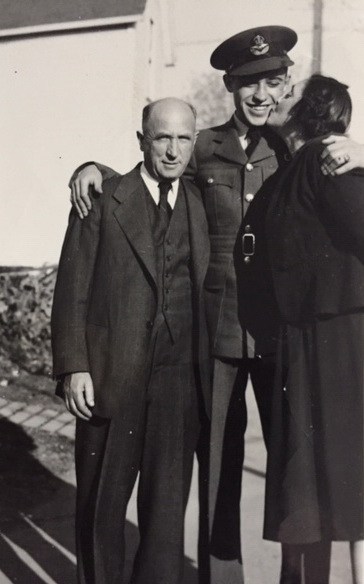
Harry Uretzky with his mom and dad before being sent overseas
According to military records, Uretzky was 22 years old when he interrupted his studies in agriculture at the University of Alberta in Edmonton to enlist in late 1941.
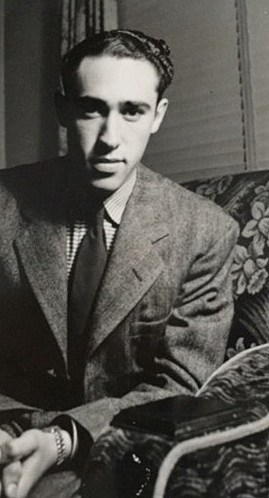
Harry Uretzky before graduating
“A fine appearing boy. Well mannered. His voice and speech are good. Keen for pilot duties. Recommended P or O. [Pilot or Observer/bomb aimer].”
After six months training at air schools in Canada, Uretzky earned his commission as a bomb aimer. By November 1942, he was en route to England to join Bomber Command.
Newspaper clipping; Harry Uretzky arrives safely overseas
Harry’s personality speaks across the years through his private diary entries. They portray a young man far from home for the first time, exploring the nightlife and sights of wartime England, but also fully aware that at this point in the war, Germany was winning.
The diary contains three of Uretzky’s poems, printed in neat handwriting. These poems were written shortly after Uretzky arrived in England. He was still waiting around at the #3 Personnel Reception Centre in Bournemouth.
He wrote the first poem on a train to London. Harry was with his friend Mickey Dlin, also of Edmonton. Dlin had recently survived the crash of his Sunderland patrol plane off the coast of West Africa. He was back in England on “survivor’s leave.”
Oh you balloons up in the sky, Protecting us from way up high, Floating gently in the air, To give our enemies the scare. A pretty sight to us below, Giving us a damn good show, Tendrils hanging one by one, Alert to catch the unwary Hun. Oh pray do not lose your gas, Or you will fall upon your ass. And they will bomb us from up high, These dirty Huns, there in the sky.
Ode to a Barrage Balloon, by Harry Uretzky, Nov. 23, 1942.
The remaining poems show Uretzky was still an idealistic, untested twenty-something, although eager to prove himself in battle. He was proud of his role as a bomb aimer.
The bomber stands, all set to go, Ready and waiting for the big show. The crew climbs in and takes its place, Soon to start on “The Death’s Race”. The engines start, the motors sing, And now the aircraft takes to wing, It moves away into the dark, As on they head towards their mark. Flying high above the clouds. Amongst imaginary gods The bomber roars upon its way The wary Hun to try and slay. The crew is sure, yet tense and grim, And now the time is growing slim, The target gradually draws near, And the bomber’s eyes begin to peer. But now the searchlights swing their beam, Probing for us, yet unseen. Long, ghost-like fingers in the night To trap us all within their light. And now the ack-ack starts to chat, Our aircraft rocks this way and that. The air is bright with brilliant flashes Hoping to turn us into ashes. “Steady” cries the man in the nose. The one who delivers the deadly blows. Who drops his bombs, so straight & sure. Upon those targets in the Ruhr. The pilot holds her steady and sure, The bomb doors open with a whir, All bombs are fused, the settings rights, Steady, steady, is the word this night. “Bombs gone” he cries, – he’s dropped them right, And they speed away into the night, Now for that day, their job is done, But tomorrow, again, they carry on.
Bomber Attack by Harry Uretzky, Nov.24/42
Not long after the poems were written, Uretzky arranged to spend another leave with Dlin, and a third pal from Edmonton, Alex Podolsky, who was in England with the crack RAF #83 Pathfinder Squadron. Although most air crews in Bomber Command in 1943 did not survive that long, Podolsky was well on the way to completing his required tour of 30 missions. Uretzky couldn’t know how prophetic his next diary entry would be.
Arrived in London and met Mick & Alex – Boy what a reunion. It was sure swell to see that little bugger Podolsky again. Mick managed to get another extension, but will probably be going back to Africa next week. Don’t know when I’ll see Alex again, either. I’m hoping we all last through this mess, God willing & can start all over again.”
Dec 4/42
Admitting he was homesick, Uretzky told his diary how much he appreciated his family: His parents Alex and Sara, and brother Abe, an engineer.
Just finished writing a letter home – my 11th home. I’m kind of homesick, you know. Funny but I didn’t think I would be… I know I’ll see them again, but not so soon. I’m kind of worried about them because they’re so sensitive. They’re parents like nobody ever had, & I pray to God, that they won’t worry too much & will keep them well. If I can finish my tour of ops [30 missions] ok I’m heading for home just as fast as I can get there. And boy what a homecoming that’ll be.
December 15/42
A week later, Uretzky officially “crewed up” at an RAF base in Pershore, with a pilot, four other Canadian airmen and one Brit. They would train together for the next four months, flying over the British countryside, practising bombing manoeuvres. These flights were often deadly in their own right. Uretzky sounded shocked by news of his friends’ crash due to engine failure.
Most of the crew of M for Mother got it. That was George’s kite. [ed note: Bomb Aimer George Weston of Vancouver. “Kite” is air force slang for plane.]…I hope to God he’s OK but won’t know for sure until tomorrow. About three weeks ago, I had a thought. That Davie & I would get through this mess & Georgie wouldn’t. If Georgie’s had it, I hope the rest of this thought is true, for Mother’s, Dad’s & Abe’s sake.
January 29/43
Davie could have been RCAF Sgt. David Slabotsky, of Montreal, also Jewish, and in training as an air gunner at Harry’s current base. Several diary references refer to Davie, including one when the two were drunk.
Uretzky attended his friend George’s funeral at the base cemetery in early February. But there was no time to deal with his sorrow. Harry experienced some close calls himself during stepped-up training before going “operational” against targets in German-occupied Europe.
In the night flight our starboard engine coughed, sputtered but finally came back. Later on when climbing, revs dropped down & we nearly had it, but Ken threw her in automatic, dived her & we were OK. On return, the nav. lights wouldn’t work & we circled for ½ an hr, before we could finally get in.
Feb.3/43
Fear wasn’t something the airmen talked about, at least not publicly. Few fliers wanted to face the shame of being sent to special psychiatric hospitals for displaying what the air force deemed “Lack of Moral Fibre.” In April 1943, Uretzky’s training ended. He was sent to RAF Leeming to the RCAF #408 “Goose” Squadron. However, during one quick leave to London, Harry received terrible news.
Went to London for leave for Pesach. There, I received a cable from Mr. Podolsky that Alex went missing. God help him. I love the kid.
Harry entered the rotation with #408 Squadron a few days later. He did not sound like someone who expected to be killed, at least not yet. His first flight – mine laying – was successful. The second mission, a month later, was a night operation to bomb Dortmund, Germany.
It’s just about a month since my first op. & here comes the second tonight. It’s a good one – right in Happy Valley, Dortmund. The way the Lanc. boys flooded the place you wouldn’t think there’d be much left, but I guess there is, some left. But anyway by this morning, the place should be as flat as a pancake. See you tomorrow, fellow—fingers crossed.
May 23/43
Uretzky’s plane was shot down during the raid. His family was told only that he was missing. Later, forensic investigators learned there were four crashes that night in the same area. The German army buried all the 25 Allied casualties in 10 collective graves near the crash site in Dortmund.
Two of Uretzky’s crewmates, the pilot and the rear gunner, were positively identified. But for the others, including Harry Uretzky and air gunner David Slabotsky, the Air Force could not be certain. They put down “no known grave.” The Edmonton student was just 25 years old. Slabotsky, the Montrealer, was 22.
“I realize that this is an extremely distressing letter and that there is no manner of conveying such information to you that would not add to your heartaches,” RCAF Wing Commander W.R. Gunn wrote to Harry’s brother Abe, explaining the results of the investigation.
Hering, Abe’s daughter, revealed how Harry’s death affected the family.
“My grandmother never got over Harry’s death,” she said. “Until she died at 96 years of age, I believe she hoped for many years that he would turn up somewhere after the war.”
Harry’s name is engraved on the Runnymede Memorial in England, which lists 20,000 Allied air personnel lost in the Second World War with no known grave. Alex Podolsky is buried in Prague, Czech Republic. The third member of the trio, Mickey Dlin, survived the war and returned home to Edmonton to marry Podolsky’s sister, Sybil.
This Remembrance Day will be even more poignant for Hering and the extended family. Her brother, Dr. Rick Uretsky of Edmonton, who had also wanted Harry’s diary and poetry to be made public, died Monday, before this story could be published.
To watch the 2020 Canadian National Jewish Remembrance Day ceremony online on Wednesday Nov. 11, 2020, please click here beginning at 10:50 a.m. Toronto time. The ceremony is produced by the Jewish War Veterans of Canada and B’nai Brith Canada, with the participation of the Minister of Veterans Affairs, Conservative Party leader Erin O’Toole, and others, including Bessner.
Ten Holocaust survivors who have made it their mission to educate younger generations about the dangers of antisemitism and racism were honoured by the Ontario government in a virtual ceremony on Nov. 5.
The annual ceremony, usually held at Queen’s Park, was scheduled for last spring but postponed due to COVID. This year’s virtual event was held during Holocaust Education Week, Nov. 2-9.
The theme of this year’s event was “passing the torch” – fitting, given that the honourees were all speakers at the Neuberger Holocaust Education Centre and had dedicated hours to talking to students about their experiences, said Fran Sonshine national chair of the Canadian Society for Yad Vashem, in remarks that were recorded earlier at the Holocaust memorial in Toronto’s Earl Bales Park.
This year’s honorees were Hedy Bohm, Esther Fairbloom, Pola Goldhar, Denise (Fikman) Hans, Mark Lane, Faigie (Schmidt) Libman, Rose Lipszyc (née Handelsman), Captain Martin Maxwell, Andy Réti and Gershon Israel Willinger.
Each honoree had received a certificate, often surrounded by their children and grandchildren, in outdoor ceremonies recorded earlier.
The survivors spoke briefly, often thanking Canada for taking them in after the Second World War, and giving them a second chance to build a life – and about the importance of teaching young people about the Holocaust.
“I hope in the future to continue Holocaust education,” said Bohm. “My goal has been and always was to make young people feel empowered to stand up and speak against any type of prejudice.”
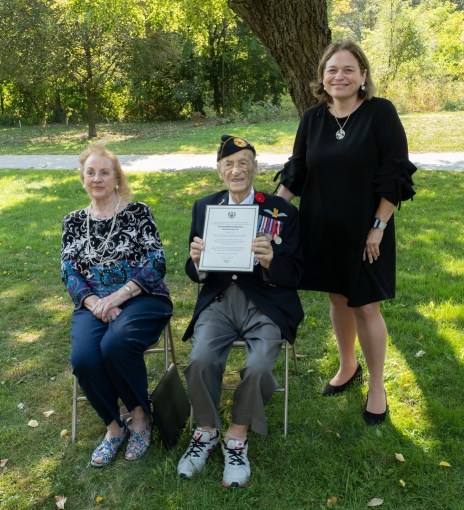
Debbie Estrin of the Canadian Society for Yad Vashem presents a tribute from the government of Ontario to Capt. Martin Maxwell. Looking on is Maxwell’s wife, Eleanor. (Photo courtesy Canadian Society for Yad Vashem)
MPPs Roman Baber, Will Bouma, Rima Berns-McGown, Gila Martow, and Steven Del Duca, leader of the Liberal Party of Ontario, introduced each honoree.
Premier Doug Ford praised the honourees’ “unbelievable bravery,” saying their “resilience and strength continue to inspire me.”
Galit Baram, consul general of Israel in Toronto and Western Canada, and a descendant of Holocaust survivors, spoke about the “alarming rise” of antisemitism, assaults and Holocaust denial, even in democratic, western societies.
“What I have to come to realize is that the Sisyphean task of combating antisemitism necessitates continuous activity on three levels: legislation, prosecution and education,” Baram said in her remarks.
“Every time elected officials speak up against antisemitism and draw the line between what is acceptable and what is not, every time a Holocaust survivor provides testimony, every time a story of the Righteous Among the Nations is told in public, every step brings us closer to developing an antidote to hatred and racism,” Baram said.
In a year characterized by increased antisemitism frequently linked to COVID conspiracy theories and social unrest caused by the lingering effects of systemic racism, it seemed only natural that Holocaust Education Week 2020 would tackle some of the the underlying conditions that contribute to such activities. In a quickly changing world, it is more relevant than ever that we understand the role Holocaust education can and does play in fostering an inclusive society that respects all Canadians.
Holocaust Education Week (HEW) runs Nov. 2-9 with programs continuing throughout the month. This year’s theme, Hindsight 2020, developed by UJA’s Neuberger Holocaust Education Centre, the organizer of the event, aims to do just that. By reflecting on the role that Holocaust education has played in our community, and promoting best practices in education that encourages deep learning, a solid foundation is laid for dealing present day challenges.
Now more than ever, nurturing Canadian civil society through the lessons of the Holocaust is a vital goal of HEW.
In response to the pandemic, the Neuberger has transformed Holocaust Education Week into a digital experience continuing throughout the year. By partnering with the Virtual J, programs will be presented live, free of charge and available for viewing on-demand long after the conclusion of each presentation.
Dara Solomon, the Neuberger’s executive director, commented on the new format: “Partnering with the Virtual J extends the reach of our programming to diverse audiences everywhere. Now, anyone with internet access can learn about the Holocaust wherever they live, at any time of day assured that the programming is built on the best and highest pedagogical standards,” she said.
HEW’s opening night unpacks the theme with American journalist Yair Rosenberg addressing the role Holocaust education and memory play in combatting the threats of contemporary antisemitism, prejudice, and fascism. He and Canadian journalist Sarah Fulford, editor-in-chief of Toronto Life magazine, will respond to some of today’s most pressing questions, including how and where does Holocaust education fit in to our current situation, and what have we learned from the Holocaust as a society that can better inform our future and point us towards a more just, equitable, and peaceful world?
A carefully curated film series that delves deeply into this year’s theme runs from November until next April. Each screening features special guest speakers, such as actor George Takei of Star Trek fame. As a child, Takei, along with other North Americans of Japanese heritage, was subject to forced relocation to internment camps during the Second World War. He has written a graphic memoir about his childhood experiences, titled They Called Us Enemy, which is an important entry point into learning about how our countries responded domestically while fighting fascism in Europe.
Takei’s personal insights provide yet another aspect of how the Second World War affected Canadians and Americans.
“For Canadians grappling with what our nation’s wartime conduct means, it helps provide a more complete picture and encourages dialogue on the significance of human rights in today’s civil society,” said Solomon.
Another not-to-be-missed program features philosopher and cultural commentator Susan Neiman, who will share her insights into grappling with the past and its significance with respect to contemporary memorial culture. A three-part Neuberger book talk series is devoted to her recent publication Learning from the Germans. Guest presenters are featured weekly and the series culminates with a discussion with Neiman.
HEW’s closing program will feature Holocaust survivor Pinchas Gutter’s personal reflections on the impact of Holocaust education and remembrance. Gutter, has spoken internationally about his Holocaust experiences, published his memoirs Memories in Focus with the Azrieli Foundation, and was one of the first to be interviewed for the USC Shoah Foundation’s Dimensions in Testimony program.
In conversation with the Neuberger’s Education Coordinator, Michelle Fishman, herself the granddaughter of Holocaust survivors, Gutter will expand on the role and power of education in combatting inequality, racism, fascism, and antisemitism.
A special tribute marking the 82nd anniversary of Kristallnacht, when a wave of violent anti-Jewish pogroms rampaged across Nazi Germany on Nov. 9 and 10, 1938, is also part of this program.
Visit the Neuberger’s website www.holocausteducationweek.com for a complete listing of all programs.
Carson Phillips, PhD, is Managing Director of the Neuberger Holocaust Education Centre of UJA Federation of Greater Toronto
Representatives from the Israeli consulate in Toronto and the Canadian Society for Yad Vashem travelled to northern Ontario last week to honour a Dutch family that sheltered Jews during the Holocaust.
Background: Jordan Falkenstein, Director of Government Relations at the Consulate General of Israel in Toronto and Western Canada. Foreground (l-r): Jonathan Allen, executive director, Canadian Society of Yad Vashem; Nora Visser; Israeli Consul General Galit Baram; Carman Kidd, Mayor of New Liskeard; and John Vanthof, MPP for Timiskaming—Cochrane. (photo courtesy Israel Consulate)
Reinerus and Cornelia Hulsker were recognized as Righteous Among the Nations at a ceremony held in New Liskeard on Oct. 16. The couple’s daughter, Nora Visser, accepted the posthumous honour.
In 1940, when the Germans invaded the Netherlands, David (Dik) Biet, a Jew, was sheltered in the Hulsker home, while his wife and infant daughter were hidden in the home of a former work colleague, Jos Asselbergs.
Visser, who was between 10 and 13 years old during the war, transported documents between the houses, said Jonathan Allen, executive director of the Canadian Society for Yad Vashem.
“I was scared when I went to the other house,” Visser told CTV News at the ceremony. “I thought they might see me. It felt like a long walk.”
In 1945, Biet was captured while visiting his wife and daughter, who were in hiding at the Asselbergs, and the family was deported to Westerbork, a transit camp. The war ended before they could be taken to a concentration camp, Allen told the CJR.
“It is quite emotional when you hear the story of what the family did to protect Jews during the Holocaust, at the risk of their own safety and the safety of their families,” Allen said.
As a descendant of Holocaust survivors and an Israeli diplomat, Galit Baram, Israel’s Consul General of Israel in Toronto and Western Canada said she was “grateful for the opportunity to share the remarkable story of the Hulsker and Asselbergs families.” Baram said ceremonies such as this “have tremendous educational value, especially since even today, 75 years after the end of World War II, with the horrors of the Holocaust so well documented, there are still many reported cases of antisemitism even in the strongest of democracies.”
The ceremony recognizing the courage of Visser’s parents was delayed several times due to COVID, and was finally held at St. Paul’s United Church in Visser’s hometown of New Liskeard.
In attendance were Carman Kidd, the mayor of New Liskeard, and local MPP John Vanthof.
Visser was interviewed at the ceremony about her experiences during the war by her granddaughter.
“A lot of details of the story came out,” Allen said. “I’m not sure how much she had shared of this in the past” with her grandchildren.
Receiving the award was “a great honour,” Visser said.
Next month, members of the Asselbergs family, who moved to Calgary after the war, will be honoured as Righteous, Allen said.
The Righteous Among the Nations project was established by Yad Vashem in 1963 to honour non-Jews who assisted Jews during the Holocaust. To date, the award has been granted to more than 27,000 recipients.
Halton Regional Police, west of Toronto, no longer consider the defacing of a memorial dubbed a “Nazi monument” to be a hate crime and regret any “hurt” arising from the incident.
The event provoked a firestorm on social media, with many questioning why a monument to a World War II-era pro-Nazi unit exists in Canada at all.
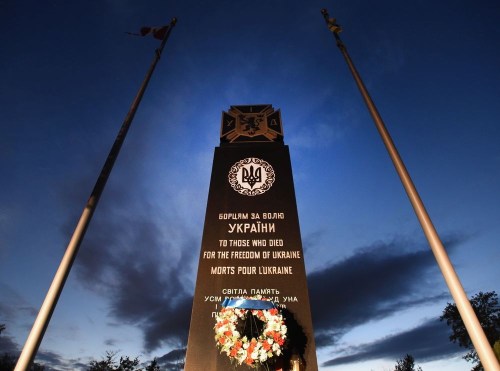
The episode began on June 22 when Halton police were called to St. Volodymyr Ukrainian Cemetery in Oakville to examine graffiti on a monument in the graveyard.
Someone had painted “Nazi war monument” on a stone cenotaph commemorating those who served with the 14th SS Division in the Second World War.
Also known as the 14th Waffen Grenadier Division of the SS, the paramilitary unit was comprised predominantly of Ukrainians and ethnic Ukrainians from the region of Galicia, according to historian Gordon Williamson.
Formed in 1943, it was part of the Waffen SS, the military branch of the SS. Members of the unit have been accused of killing Polish civilians and Jews during the war.
According to a Halton Regional Police statement, the initial information collected by investigators indicated that the graffiti “may have been hate-motivated, targeting the identifiable group of Ukrainians in general, or Ukrainian members of this cultural centre.”
After reporting and social media posts revealed that the monument pays tribute to a pro-Nazi unit, police changed course.
“At no time did the Halton Regional Police Service consider that the identifiable group targeted by the graffiti was Nazis,” said a July 17 statement from police.
“We regret any hurt caused by misinformation that suggests that the [police] service in any way supports Nazism,” it added.
Police are now treating the incident as a case of vandalism, said Det. Sgt. Barrett Gabriel. The investigation continues, police said.
Halton Regional Police Chief Stephen Tanner went further on Twitter, questioning the reason for the monument.
“The most unfortunate part of all this is that any such monument would exist in the first place,” he tweeted, as reported by the Ottawa Citizen.
“To those who died for the freedom of Ukraine,” states the cenotaph’s inscription. But it also displays the crest of the 14th Waffen SS division, whose members are alleged to have taken part in killing hundreds of Polish civilians in 1944 in the village of Huta Pieniacka, the Citizen added.
The memorial has been in the privately-owned cemetery for years.
Oakville Mayor Rob Burton issued a statement saying the city has little influence in this matter.
“Unfortunately, municipalities have no role in regulating the contents of private cemeteries. [The memorial is] personally repugnant to me. I have family who died fighting Nazis.
“If Ontario laws permitted me to have it removed, it would have been gone 14 years ago,” Burton said, according to insidehalton.com.
On July 18, the Ukrainian Canadian Congress sent a letter to the Ottawa Citizen about the paper’s coverage of the incident.
The Citizen article “propagates the narrative originating from the Russian Embassy in Canada that Ukrainians in general, and particularly all Ukrainians who took up arms against the Soviet Union during the Second World War, are ‘fascists’ and ‘Nazis,’” the letter stated.
Labeling Ukrainians as Nazis is “part of Russia’s ongoing effort to sow division in Canada and other Western democracies,” said the letter. The Russian campaign is “disinformation.”
The letter said veterans of the Galicia Division “never fought against Allied forces,” and were screened by the Allies before being allowed to immigrate to Canada.
The 1986 Deschenes Inquiry into Nazi-era war criminals in Canada “cleared these veterans of any involvement in war crimes…” said the letter, signed by Ihor Michalchyshyn, CEO of the Ukrainian Canadian Congress.
The memorial in question is not the only problematic one in Canada.
As the CJR reported recently, another is a bust of Roman Shukhevych, located at the entrance of the Ukrainian Youth Unity Complex in Edmonton’s north end.
Shukhevych was supreme commander of the Ukrainian Insurgent Army (UPA) during World War II and held leadership positions in the Organization of Ukrainian Nationalists, correspondent Paula Kirman wrote.
“While viewed as a hero by Ukrainian nationalists for his anti-Soviet posture, Shukhevych shared the Nazi ideology and was responsible for commanding troops that committed massacres with the goal of creating an ethnically ‘pure’ Ukraine free of Poles, Jews, and many others during the Holocaust,” Kirman wrote.