
Remembrance Day – and One Jewish Airman’s War Diary

By ELLIN BESSNER

As Canadian Jews mark Remembrance Day today, one of the names of the fallen they might see on war cenotaphs across the country is that of Flying Officer Harry Uretzky.
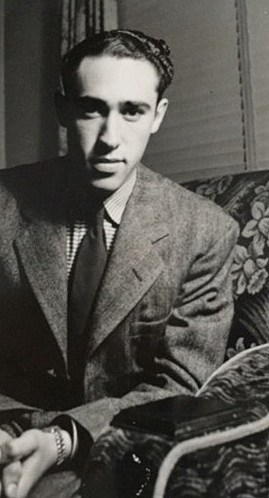
Harry Uretzky

Uretzky is one of nearly 450 Jewish Canadians who didn’t come home from the Second World War. He was among the 17,000 Canadian Jewish soldiers, sailors, airmen and women who helped defeat Adolf Hitler and rescue survivors of the Holocaust.

His family and friends knew what a gifted writer the young Edmonton man was. Now, for Remembrance Day, Uretzky’s niece, Karen Hering, has released her late uncle’s war diary with a collection of his poetry. Hering and her siblings decided to publicize Harry’s story as part of their journey to learn more about the uncle they never knew. 
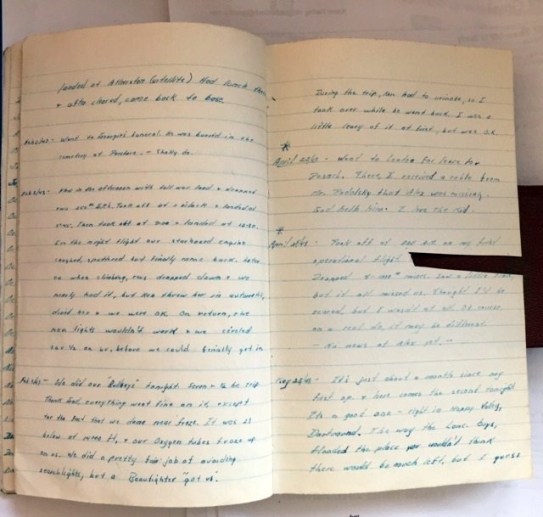
Harry Uretzky‘s diary; page 9-10 Feb-May 1943

“It was a very sensitive, traumatic topic with my grandmother, and therefore my father (Abe, Harry’s older brother) so Harry was rarely spoken of,” Hering said in a recent email. “It was only after my grandmother passed away that we found the small box of artifacts about my uncle and we became more interested in his story. By then, my parents had long been dead and just about anyone else who might have known him.”
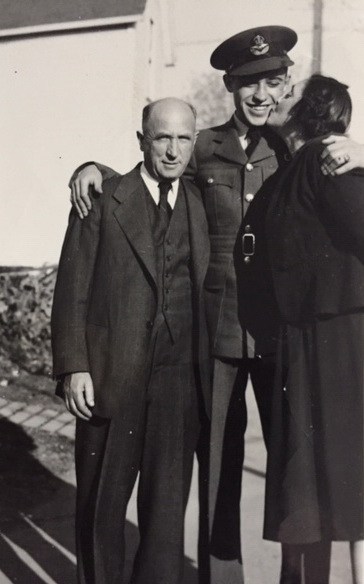
Harry Uretzky with his mom and dad before being sent overseas

According to military records, Uretzky was 22 years old when he interrupted his studies in agriculture at the University of Alberta in Edmonton to enlist in late 1941. 

Harry Uretzky before graduating

A fine appearing boy. Well mannered. His voice and speech are good. Keen for pilot duties. Recommended P or O. [Pilot or Observer/bomb aimer].”

After six months training at air schools in Canada, Uretzky earned his commission as a bomb aimer. By November 1942, he was en route to England to join Bomber Command.

Newspaper clipping; Harry Uretzky arrives safely overseas

Harry’s personality speaks across the years through his private diary entries. They portray a young man far from home for the first time, exploring the nightlife and sights of wartime England, but also fully aware that at this point in the war, Germany was winning. 

The diary contains three of Uretzky’s poems, printed in neat handwriting. These poems were written shortly after Uretzky arrived in England. He was still waiting around at the #3 Personnel Reception Centre in Bournemouth. 

He wrote the first poem on a train to London. Harry was with his friend Mickey Dlin, also of Edmonton. Dlin had recently survived the crash of his Sunderland patrol plane off the coast of West Africa. He was back in England on “survivor’s leave.” 

Oh you balloons up in the sky,
Protecting us from way up high,
Floating gently in the air,
To give our enemies the scare.
A pretty sight to us below,
Giving us a damn good show,
Tendrils hanging one by one,
Alert to catch the unwary Hun.
Oh pray do not lose your gas,
Or you will fall upon your ass.
And they will bomb us from up high,
These dirty Huns, there in the sky.

Ode to a Barrage Balloon, by Harry Uretzky, Nov. 23, 1942.

The remaining poems show Uretzky was still an idealistic, untested twenty-something, although eager to prove himself in battle. He was proud of his role as a bomb aimer. 

The bomber stands, all set to go,
Ready and waiting for the big show.
The crew climbs in and takes its place,
Soon to start on “The Death’s Race”.
The engines start, the motors sing,
And now the aircraft takes to wing,
It moves away into the dark,
As on they head towards their mark.
Flying high above the clouds.
Amongst imaginary gods
The bomber roars upon its way
The wary Hun to try and slay.
The crew is sure, yet tense and grim,
And now the time is growing slim,
The target gradually draws near,
And the bomber’s eyes begin to peer.
But now the searchlights swing their beam,
Probing for us, yet unseen.
Long, ghost-like fingers in the night
To trap us all within their light.
And now the ack-ack starts to chat,
Our aircraft rocks this way and that.
The air is bright with brilliant flashes
Hoping to turn us into ashes.
“Steady” cries the man in the nose.
The one who delivers the deadly blows.
Who drops his bombs, so straight & sure.
Upon those targets in the Ruhr.
The pilot holds her steady and sure,
The bomb doors open with a whir,
All bombs are fused, the settings rights,
Steady, steady, is the word this night.
“Bombs gone” he cries, – he’s dropped them right,
And they speed away into the night,
Now for that day, their job is done,
But tomorrow, again, they carry on.

Bomber Attack by Harry Uretzky, Nov.24/42

Not long after the poems were written, Uretzky arranged to spend another leave with Dlin, and a third pal from Edmonton, Alex Podolsky, who was in England with the crack RAF #83 Pathfinder Squadron. Although most air crews in Bomber Command in 1943 did not survive that long, Podolsky was well on the way to completing his required tour of 30 missions. Uretzky couldn’t know how prophetic his next diary entry would be.

Arrived in London and met Mick & Alex – Boy what a reunion. It was sure swell to see that little bugger Podolsky again. Mick managed to get another extension, but will probably be going back to Africa next week. Don’t know when I’ll see Alex again, either. I’m hoping we all last through this mess, God willing & can start all over again.”

Dec 4/42 

Admitting he was homesick, Uretzky told his diary how much he appreciated his family: His parents Alex and Sara, and brother Abe, an engineer.

Just finished writing a letter home – my 11th home. I’m kind of homesick, you know. Funny but I didn’t think I would be… I know I’ll see them again, but not so soon. I’m kind of worried about them because they’re so sensitive. They’re parents like nobody ever had, & I pray to God, that they won’t worry too much & will keep them well. If I can finish my tour of ops [30 missions] ok I’m heading for home just as fast as I can get there. And boy what a homecoming that’ll be.

December 15/42 

A week later, Uretzky officially “crewed up” at an RAF base in Pershore, with a pilot, four other Canadian airmen and one Brit. They would train together for the next four months, flying over the British countryside, practising bombing manoeuvres. These flights were often deadly in their own right. Uretzky sounded shocked by news of his friends’ crash due to engine failure.

Most of the crew of M for Mother got it. That was George’s kite. [ed note: Bomb Aimer George Weston of Vancouver. “Kite” is air force slang for plane.]…I hope to God he’s OK but won’t know for sure until tomorrow. About three weeks ago, I had a thought. That Davie & I would get through this mess & Georgie wouldn’t. If Georgie’s had it, I hope the rest of this thought is true, for Mother’s, Dad’s & Abe’s sake.

January 29/43

Davie could have been RCAF Sgt. David Slabotsky, of Montreal, also Jewish, and in training as an air gunner at Harry’s current base. Several diary references refer to Davie, including one when the two were drunk.

Uretzky attended his friend George’s funeral at the base cemetery in early February. But there was no time to deal with his sorrow. Harry experienced some close calls himself during stepped-up training before going “operational” against targets in German-occupied Europe. 

In the night flight our starboard engine coughed, sputtered but finally came back. Later on when climbing, revs dropped down & we nearly had it, but Ken threw her in automatic, dived her & we were OK. On return, the nav. lights wouldn’t work & we circled for ½ an hr, before we could finally get in. 

Feb.3/43

Fear wasn’t something the airmen talked about, at least not publicly. Few fliers wanted to face the shame of being sent to special psychiatric hospitals for displaying what the air force deemed “Lack of Moral Fibre.” In April 1943, Uretzky’s training ended. He was sent to RAF Leeming to the RCAF #408 “Goose” Squadron. However, during one quick leave to London, Harry received terrible news.

Went to London for leave for Pesach. There, I received a cable from Mr. Podolsky that Alex went missing. God help him. I love the kid. 

April 23/43

Podolsky, who was a manager of his family’s well known Edmonton dry cleaning business, Dollar Cleaner, was killed during a raid on then-Czechoslovakia on April 17, 1943.

Harry entered the rotation with #408 Squadron a few days later. He did not sound like someone who expected to be killed, at least not yet. His first flight – mine laying – was successful. The second mission, a month later, was a night operation to bomb Dortmund, Germany.

It’s just about a month since my first op. & here comes the second tonight. It’s a good one – right in Happy Valley, Dortmund. The way the Lanc. boys flooded the place you wouldn’t think there’d be much left, but I guess there is, some left. But anyway by this morning, the place should be as flat as a pancake. See you tomorrow, fellow—fingers crossed.

May 23/43

Uretzky’s plane was shot down during the raid. His family was told only that he was missing. Later, forensic investigators learned there were four crashes that night in the same area. The German army buried all the 25 Allied casualties in 10 collective graves near the crash site in Dortmund.

Two of Uretzky’s crewmates, the pilot and the rear gunner, were positively identified. But for the others, including Harry Uretzky and air gunner David Slabotsky, the Air Force could not be certain. They put down “no known grave.” The Edmonton student was just 25 years old. Slabotsky, the Montrealer, was 22.

“I realize that this is an extremely distressing letter and that there is no manner of conveying such information to you that would not add to your heartaches,” RCAF Wing Commander W.R. Gunn wrote to Harry’s brother Abe, explaining the results of the investigation.

Hering, Abe’s daughter, revealed how Harry’s death affected the family. 

“My grandmother never got over Harry’s death,” she said. “Until she died at 96 years of age, I believe she hoped for many years that he would turn up somewhere after the war.”

Harry’s name is engraved on the Runnymede Memorial in England, which lists 20,000 Allied air personnel lost in the Second World War with no known grave. Alex Podolsky is buried in Prague, Czech Republic. The third member of the trio, Mickey Dlin, survived the war and returned home to Edmonton to marry Podolsky’s sister, Sybil. 

This Remembrance Day will be even more poignant for Hering and the extended family. Her brother, Dr. Rick Uretsky of Edmonton, who had also wanted Harry’s diary and poetry to be made public, died Monday, before this story could be published.


Ellin Bessner is a Toronto journalist and the author of “Double Threat: Canadian Jews, the Military and WWII (2019)”,  published by the University of Toronto Press. Her book is available at all major booksellers. 

To watch the 2020 Canadian National Jewish Remembrance Day ceremony online on Wednesday Nov. 11, 2020, please click here beginning at 10:50 a.m. Toronto time. The ceremony is produced by the Jewish War Veterans of Canada and B’nai Brith Canada, with the participation of the Minister of Veterans Affairs, Conservative Party leader Erin O’Toole, and others, including Bessner. 
EXCLUSIVE: Report on Clash at York U Suggests Clarifying Free Speech, Beefing up Security

EXCLUSIVE to the CJR: Report on Clash at York U Suggests Clarifying Free Speech, Beefing up Security

By LILA SARICK

An independent review by a former Supreme Court of Canada judge on a violent clash at York University last November recommends that the university clarify the limits of free speech and legitimate protest, beef up its security policies, and give campus police expanded powers.

The 81-page report, authored by former high court justice Thomas Cromwell and released June 2, examined the events of Nov. 20, 2019, when Students Against Israeli Apartheid (SAIA) confronted pro-Israel supporters at a program sponsored by Herut Canada that brought Israel Defense Forces (IDF) reservists to York.

“Even a casual look at the extensive video of the event shows what a dangerous situation existed in Vari Hall that evening,” Cromwell’s report states. “The video shows verbal and physical altercations. York Federation of Students marshals, York security officers and TPS (Toronto Police Services) officers are shown acting as physical barriers between event supporters and protestors.”

Honourable Thomas A. Cromwell C.C

Cromwell was asked by York president Rhonda Lenton to examine the university’s policies on freedom of speech, how it provided space for student events, and security arrangements.

Cromwell interviewed 22 groups and individuals and received nine written submissions. The York Federation of Students did not participate in the review, despite being sent emails, voicemails and a hand-delivered letter, he noted.

Lenton said the university is committed to implementing all 41 of Cromwell’s recommendation within 12 months, with many ready to roll out when school starts in September.

“The most important piece of the document is that it helps universities understand the limits to freedom of speech. It was very helpful that Cromwell was trying to understand the unique characteristics of the university,” Lenton said in an exclusive interview with the CJR.

Rhonda L. Lenton, PhD, President, York University

“You get people referring to (speech) and asking has it broken the law. Inciting hatred is a very high bar, if that’s the only bar, you cannot rely on that legal bar, you must create additional conditions that allow the university to function,” she said.

“Our goal is to allow our community to debate and have vigorous conversation, but in a safe, civil environment,” Lenton continued. “You can vehemently disagree with a position but this name-calling and heckling should not be acceptable because then students don’t feel safe to express their own views.”

Among York’s first tasks will be to clearly define acceptable speech, what constitutes discrimination and harassment, and the consequences for violating the university’s codes, Lenton said.

“If you keep it theoretical and argue how to define freedom of speech without specifics, it is very difficult to implement,” she said. “We need clarity on policy and definitions: how does the university define freedom of speech and what will be tolerated.”

The university also needs to establish a transparent response if groups do not adhere to the policies. “These procedures will help us keep the university a safe place,” Lenton said.

The third element of Cromwell’s report refers to education and training for student leaders about the limits of free speech and what constitutes racism and discrimination.

York has “tremendous success” with faculty teaching controversial subjects, and has student groups that encourage building bridges in the diverse university community, Lenton said. “We want to build on those positive measures.”

While the report did not specifically address antisemitism on campus, Lenton, who is Jewish, acknowledged that the Jewish community has specific concerns.

In a two-page letter accompanying the report, she wrote, “We want to speak directly to the Jewish community for a moment. We have heard your serious concerns and know that we have work to do…. We cannot police the beliefs of our community members, but we can strengthen our policies and procedures to protect our community from abhorrent views and actions.”

In the CJR interview, Lenton said: “I want the Jewish community not to feel that antisemitism will get lost in this broader focus on freedom of speech. It will not.”

Late last year, both Herut Canada and SAIA were temporarily suspended from York, but the groups will not face any further discipline, Lenton said, acknowledging that “this will be a challenge for those who feel further actions were warranted.”

Cromwell’s report exposes the frustrations that student groups and the larger community have had with York’s handling of divisive issues.

“My review revealed deep concern about the university’s ability to address conduct that was viewed as constituting racism, discrimination and harassment,” Cromwell wrote.

Cromwell referenced a submission from B’nai Brith Canada, which said SAIA had a “long history of fomenting anti-Israel disruptions on campus.” The Canadian-Arab Anti-Discrimination Committee urged Cromwell to “investigate and note the discrimination, or at least inadequate regard for the concern, rights and security of students protesting the event.”

Among Cromwell’s recommendations are for York to develop clear definitions of what constitutes racism, discrimination and harassment, especially in relation to extra-curricular activities and to follow the model of other universities and create a unified complaint process, a “one-stop shop” to adjudicate complaints.

On the topic of free speech, Cromwell wrote that speech cannot be restricted simply because it is offensive. However, the university needs to clarify and provide practical examples, that “expression that takes the form of violence, threats of violence, hate speech and/or discriminatory conduct…is not permissible on campus.”

Similarly, peaceful protest is permitted, but protesters cannot physically block an event and not all university property is available for protests, he wrote.

At the Nov. 20 event, “there were a number of behaviours that impeded the Herut event and therefore exceeded the bounds of free expressions through protest,” Cromwell wrote, citing protesters who banged on the walls of the auditorium where the event was taking place and used loudspeakers near the hall.

The university also needs to establish clear guidelines about when an event should be cancelled or postponed because of concerns the speaker will “exceed the limits of free expression” or the event carries a risk of personal injury.

Among the security measures Cromwell recommends are providing designated protest zones and if necessary, restricting attendance to members of the university or to those who have pre-registered.

“Volunteer security” should be explicitly prohibited, the report said. Herut Canada had said it recruited Jewish motorcycle groups and the Jewish Defence League for security assistance at the November event. In early March, York banned JDL Canada director Meir Weinstein from its campuses “for any reason whatsoever.”

York should also consider training some of its security staff as special constables, which would give them greater authority to remove people from campus, an idea that Lenton said she would endorse.

Cromwell’s report identified numerous loopholes and gaps in the university’s policies, including practical concerns, such as how space was booked by groups, how security risks were analyzed and who should bear the cost of security for controversial speakers.

Cromwell is clear that imposing security costs on the organizers of an event that may attract protesters is “highly problematic from a free expression perspective.”

However, he noted that especially in the United States, universities have been exploited by controversial speakers who see the schools as prestigious and inexpensive venues.

Cromwell recommends that York establish a budget for extra-curricular event security. When the budget is exhausted for the year, the university can refuse to hold additional events.

UPDATE: In a statement, Barbara Bank, Toronto chair of the Centre for Israel and Jewish Affairs, thanked Lenton “for recognizing that York University is not immune from antisemitism, and her commitment to strengthen university policies and procedures to protect the campus community from abhorrent views and actions.”

Seventy-five Years in Northern Ontario … and Still Here

By TOVA ARBUS

In October 2020, Beth Jacob Synagogue in Sault Ste. Marie, Ont. will celebrate its 75th anniversary. Needless to say, our small community is quite excited about this milestone and has been planning a weekend-long celebration to mark the occasion.

Beth Jacob Synagogue in Sault Ste. Marie, Ont.

It would not surprise me to hear that many of you had no idea there is (or perhaps still is) a Jewish community in Sault Ste. Marie. Many hours away from any big city, we have to do without many of the resources and connections Jews have in larger places. With approximately 30 active families, we proudly wear the title “small but mighty.”

There has been a Jewish presence here since the mid-1880s, usually merchants of one kind or another who came from Russia, Poland and Germany by way of Montreal and Toronto. The Rosenstein and Rosenberg families were among the early arrivals. At one time, the Jewish population peaked at about 100 families in the 1950s and 60s.

The only ordained rabbi we had was Rabbi Beryl Fishman from 1931 to 1956. His son Alec led services for many years.

But children were encouraged to leave this small, isolated community in search of bigger and better opportunities, and many never returned.

Those of us who still here have watched families leave and membership decline; the average age of our current membership is over 50, and there are very few children. There is no longer an active Hebrew school, and even getting a minyan cannot always be counted on.

And yet, we are still here.

We are still here, living and worshipping as Jews. Here, in communities (Beth Jacob Synagogue serves both Sault Ste. Maries in Ontario and across the border in Michigan) where many of our neighbours and acquaintances are surprised by the presence of Jews, where people who have lived here their entire lives have no idea there is a synagogue.

It is not always easy. Kosher foodstuffs at the grocery store are practically non-existent and kosher meat must be imported. There are no Jewish community centres or schools, no programming of any kind, no real recognition by the broader community of Jewish holidays or festivals.

And yet, we are still here.

So what does it mean, really, to be Jewish in small-town Northern Ontario? It means that we hold those who are here very close. Congregation Beth Jacob has been our family and our centre since 1945.

We get together as often as we can for Shabbat services and to honour and celebrate holidays and festivals. We share food and prayer and togetherness. We support each other in finding a meaningful Jewish practice, despite the things we are not able to access. And we all work together to take care of the synagogue.

The celebratory weekend we were planning, along with many wonderful events, has been put on hold in light of COVID-19 precautions. Originally planned for October 2020, the 75th anniversary festivities will likely be pushed forward to the spring of 2021. Whenever it happens, we hope that former members will come back and join us for the milestone, recognizing the long history of survival here in Sault Ste. Marie, and once again filling the synagogue with Jewish life.

Some of the events planned include a theatrical adaptation of native son Morley Torgov’s A Good Place to Come From (if you haven’t read it, do) and an historic exhibit in partnership with our local museum. We have been collecting stories, photographs, and memories from people who grew up here, combing through archival collections and diving into the depths of the internet. It is not a small collection, and it is growing.

The Jewish community of Sault Ste. Marie might be small, isolated, and occasionally overlooked. We might have to work hard to be Jewish here. But judging from the expanding collection of photographs, artifacts, and stories, from the beautiful building that still stands, and from the strength of the community that it houses, Congregation Beth Jacob is most definitely still here.

Although a firm date is to be announced, watch for online celebrations on our website. Donations to our celebrations or to the upkeep of the synagogue can be made directly through our website, http://www.bethjacobssm.ca/

For a 360-degree view of the synagogue, visit https://synagogues360.bh.org.il/gallery/congregation-beth-jacob/

For more information, please email Tova Arbus at [email protected]