A rare cache of historic documents from Canada’s storied Hart family, among the first Jews to settle in what became Canada, is coming up for auction on Nov. 12 in New York.
The 60 legal documents to go under the hammer of the Brooklyn auction house Kestenbaum & Company relate to Aaron Hart, who arrived in Quebec in 1760, and his four sons, Moses, Ezekiel, Benjamin and Alexander.
Aaron Hart settled in Trois-Rivières and became a wealthy businessman, starting in fur trading and expanding to real estate and a wholesale store. He helped found the Shearith Israel synagogue (now the Spanish & Portuguese Synagogue) in Montreal in 1768.
His son Ezekiel was notably elected three times to the Legislative Assembly of Lower Canada, from 1807 to 1809, but was prevented from taking the seat because the oath of office included the phrase “on the true faith of a Christian.”
The manuscripts, in English and French, date from 1790 to 1805 and concern lawsuits, in which the Harts were generally plaintiffs, and a dispute between Ezekiel and his brothers over extra payments from his father’s estate. The auction house estimates they will fetch between $8,000 and $12,000 (U.S.)
“This collection serves as a veritable treasure trove of information on the Hart family, who can arguably be described as the first Jewish family to really establish roots in Canada,” Massye Kestenbaum, a cataloguer for the auction house, said in an email to the CJR.
The collection is unusual because few documents from this era in Canadian Jewish history have surfaced, Kestenbaum said.
“Despite the important roles many Jews assumed in Canada once the British took control, there is a startling paucity of scholarship on the Canadian Jewry during this period,” he related. “Part of that is simply due to there not being an overwhelming number of primary sources on the subject matter, especially this early in the history of Canadian Jewry.”
The documents, which are in a “generally good condition,” were originally in the care of Judge James Reid (1769-1848), the Hart family’s lawyer. They then passed to Robert Deveaux Woodruff Band (1927-2013), a collector of things related to Canadian history, Kestenbaum said.
The auction house has sold a few other Canadian Jewish artifacts over the years but none dating as far back as the Hart papers, Kestenbaum said.
Canadian institutions and private collectors have expressed interest in the collection. But unfortunately, the Alex Dworkin Canadian Jewish Archives in Montreal won’t be bidding on the materials, said Janice Rosen, archives director.
“We don’t have purchasing budgets,” she said. “Obviously, $12,000 U.S. isn’t going to happen.”
While the archives have photocopies of some documents from the Hart family, “we have very little original information that goes back that far,” she said.
It is hard to tell how significant the papers are, she said. “Maybe they won’t tell us a lot of new things, but if [there’s] a will, it may be interesting.”
Ultimately, the best place for the documents is a government-run archives, where they can be properly preserved and made available to researchers, Rosen said.
Library and Archives Canada in Ottawa, which oversees the Jacob M. Lowy collection of rare Judaica and Hebraica, said in a statement that it is aware of the upcoming sale, but “as in all such cases, LAC will not be commenting publicly on whether it intends to take part in the auction or not.”
MONTREAL—The long awaited court challenge to Quebec’s controversial secularism law got underway in Montreal’s Palais de Justice Nov. 2 with a young Muslim woman who wears a hijab testifying that her plans to teach in the public system have been dashed, making her feel excluded and inferior.
Bill 21, which became law in June 2019, prohibits public employees deemed to represent state authority from displaying religious symbols while on the job. These include police officers, judges, Crown prosecutors and other government lawyers, prison guards and – most widely questioned – teachers and principals in public elementary and high schools.
Ichrak Nourel Hak, the first witness at the trial, which is expected to last several weeks, had just graduated from the University of Montreal and was hoping to begin her career in a public school when the legislation came into effect. She is now teaching in the private sector, which is not subject to the law. That includes Jewish day schools.
The trial, held in Quebec Superior Court, combines four separate lawsuits against Bill 21, officially entitled “An Act Respecting the Laicity of the State.”
It was high on the agenda of the Coalition Avenir Québec which was elected with a solid majority in October 2018. The new government quickly shepherded it through the legislative process, despite sustained outcry from minority and human rights groups, legal experts, and the opposition Liberal Party.
Premier Francois Legault described the bill as a “moderate” resolution of the acrimonious debate over “reasonable accommodation” of religious practices in the public sphere. Polls have shown that a majority of Quebecers agree with him.
All four lawsuits seek the law’s annulment on constitutional grounds but will offer differing legal arguments on why it violates fundamental rights. These have to be complex because the law includes the constitutional notwithstanding clause, which allows the government to override guarantees of religious liberty and equality, including between men and women, under the Canadian Charter of Rights and Freedoms.
All of the complainants charge that the law is discriminatory against those whose religious belief requires them to wear such symbols. In practical terms, the greatest impact is on Muslim women.
The law does not specifically name what constitutes a religious symbol but the minister responsible has said it should be commonly understood to mean headwear or jewelry. The law applies to all religions, not only minorities.
Public employees who wore such symbols before the law was adopted are “grandfathered,” but only as long as they stay in the same job description.
Hak is the lead plaintiff for the first lawsuit, launched by the National Council of Canadian Muslims and Canadian Civil Liberties Union (CCLU). The others were filed by the English Montreal School Board; the Fédération autonome de l’enseignement, a teachers’ union; and three teachers – two Muslim, one Roman Catholic who wear religious symbols – who are backed by an interfaith and intercultural coalition.
Gregory Bordan, lawyer for the three teachers and an observant Jew, will argue that the relevant rights were entrenched long before the 1982 Canadian constitution, back even to Confederation in 1867.
Whatever the decision, experts believe it will be appealed and, eventually, taken to the Supreme Court of Canada – a process that could take years.
Last year, a Superior Court judge rejected a request by the Muslim council and CCLU for an injunction against parts of the law with the most direct affect on individuals until their case goes to trial. That decision was upheld by the Quebec Court of Appeal in December.
In the current trial, the court did grant intervener status to a pro-secularist group that believes the law does not go far enough.
In the debate before the federal election last October, Prime Minister Justin Trudeau said Ottawa might intervene in the court challenge, but that has not happened.
During public hearings in the spring of 2019, the Lord Reading Law Society vigorously opposed the bill saying it would create a “state religion” that imposes neutrality and deprive individuals of their fundamental rights and freedoms.
This association of Jewish lawyers believes the bill contravenes the 1948 Universal Declaration of Human Rights and 1976 International Covenant on Civil and Political Rights, to which Canada is a party.
The Centre for Israel and Jewish Affairs-Quebec termed the bill “a disproportionate attack” on basic rights, including equality of opportunity for employment, and urged that, at the minimum, teachers not be subject to it.
It also found the bill’s wording ambiguous, leaving too much discretion in the hands of administrators of public institutions in how it is applied.
B’nai Brith Canada urged the entire law be scrapped, saying it “contributes to the divisions that already exist in Quebec society” and “advocates a militant form of laicity to the detriment of religious individuals and communities that cannot be justified.”
The organization feared that hateful acts against minorities would increase.
Shabbat Shalom and welcome to “Kitchen Talk,” the weekly food blog of the CJR. The weather is getting colder and COVID rates across the country are on the rise. We’ll soon be spending much more time indoors.
However, it’s not all gloom and doom. It’ll be Zoom and more Zoom.
This technology has become quite the lifesaver during this pandemic. Thanks to Zoom, I participate in a study group with a rabbi. I attend Kabbalat Shabbat services at a synagogue in Long Island, N.Y. I listen to U.S. political lectures, and I take all kinds of cooking classes, some with top international chefs.
I’m looking forward to attending Building the Jewish & Cookbook at 2 p.m. on Nov. 8., a virtual cooking workshop hosted by the Miles Nadal JCC and The Wandering Chew, a non-profit group that embraces Montreal’s Jewish food cultures and traditions.
Kat Romanow
Wondering-Jew co-founder Kat Romanow will teach how to make her family’s recipe for Pizza Napoletana through the Jewish& Cookbook program. “Jewish&” celebrates Jewish diversity through various programs. To register: https://www.amilia.com/store/en/miles-nadal-jcc/shop/activities/2864377
Lysette’s Mock Chopped Liver is a Mexican take on chopped liver that uses avocado as the base and mixes in hardboiled eggs, caramelized onions, lemon juice, salt & pepper. Massafan is an Iranian-Jewish recipe for flourless cookies that are often eaten at Passover.
This week, the late Norene Gilletz, Canada’s Queen of Kosher Cuisine was posthumously inducted into the Taste Canada Hall of Fame. Taste Canada honours food writers, and cookbook authors.
To mark this bittersweet but special occasion, I am including a recipe for Hoisin Sesame Chicken from Gilletz’s last book, The Brain Boosting Diet: Feed Your Memory. Co-written with the late Edward Wein, The Brain Boosting Diet was on the long list of nominations for a Taste-Canada Award in the category of Health and Special Diet Cookbooks.
COMMUNITY SPOTLIGHT:
Kat Romanow promotes Montreal’s Jewish food traditions
The Wandering Chew’s Kat Romanow, director of food programming for the Museum of Jewish Montreal, says her pizza workshop for MNJCC’s Jewish& Cookbook program (Nov. 8) “marries her Italian and Jewish background.”
Romanow grew up in a close-knit Italian-Ukrainian home and was raised Roman Catholic. While doing a master’s degree in Jewish studies, she specialized in food traditions. She later converted to Judaism.
Romanow’s maternal great-grandfather, an Italian immigrant, founded the Carona Bakery in 1932 and built homes for his family next door to the bakery in Montreal’s east end.
“When the bakery was in operation it was a meeting place for the whole family living on the street,” she recalled.
The bakery, known for its Pizza Napoletana, closed in 1995. Romanow said she, her mother and grandmother were able to recreate the pizza recipe for a home-kitchen oven. She also adapted the recipe by substituting shortening for lard. This recipe will be sent to participants in MNJCC workshop.
Romanow suggested that the dough be prepared in advance because it takes 1½ hours to rise.
Romanow founded The Wandering Chew with Sydney Warshaw in 2013. “We both have a deep love of Jewish food,” she said. “Our mission is to share the diversity of Jewish stories through food.”
The pair runs cooking workshops, food events, and cookbook launches. “We were doing it all in person prior to the pandemic. Now we have moved on line. We are meeting our mission through our events and the recipe collection on the website.”
2 eggs 1 white onion, finely diced 2 avocados Juice of ½ lemon Canola oil Salt & pepper, to taste
Place the eggs in a saucepan and cover with cold water. Bring the water to a boil and immediately turn off the heat. Leave the eggs in the covered pot for 8 minutes, until hard-boiled. Drain and run the eggs under cold water. Peel and chop the hard-boiled eggs into half-inch pieces.
Heat the oil in a skillet over medium heat and add the onions. Cook the onions until caramelized, about 8–10 minutes. Set aside to cool.
Mash the avocados until smooth and mix in the onions, eggs and lemon juice.
Season generously with salt and pepper. Serve with rye bread or tortilla chips.
MASSAFAN The Wandering Chew
1 cup (250 ml) almond flour 1/3 cup (100 ml) sugar 1 egg white ½ tsp (2 ml) ground cardamom Rosewater
Mix the ground almonds, sugar and cardamom together until evenly combined.
Mix the egg white into the dry ingredients and mix with a spoon until the dough comes together. This will take around 1–2 minutes. Wet your hands with rose water and shape into stars. Continue to wet your hands with a little rose water to shape each cookie.
If freezing, place the baking sheet in the freezer until the cookies are frozen and then place the cookies in a single layer in a freezer bag.
Bake the cookies for 8–10 minutes until light golden brown. To bake from frozen, bake the cookies for 10–12 minutes until light golden brown. Yields 12 star-shaped cookies
HOISIN SESAME CHICKEN Norene Gilletz
6 boneless, skinless single chicken breasts (or 12 boneless, skinless chicken thighs) Freshly ground black pepper ¼ cup (60 ml) hoisin sauce 1 tbsp (15 ml) apricot preserves (reduced-sugar or all-fruit) 1 tbsp (15 ml) minced garlic 1 tbsp (15 ml) orange juice ¼ cup (60 ml) sesame seeds
Place the chicken on a parchment-lined, rimmed baking sheet. Sprinkle lightly with pepper on both sides.
In a medium bowl, combine the hoisin sauce, apricot preserves, garlic, and orange juice; mix well.
Brush the sauce evenly over chicken on both sides, then sprinkle sesame seeds on top. Let marinate for 30 minutes or refrigerate, covered, for 24 hours.
Preheat the oven to 400°F (200°C). Bake, uncovered, for 20–25 minutes, or until the juices run clear when the chicken is pierced with a fork. Serve hot or cold.
Norene’s Notes:
Grilled hoisin sesame chicken: Prepare and marinate the chicken as directed in Steps 1–3. Preheat the barbecue to medium-high. Grill the chicken over indirect heat for 4–6 minutes per side, or until the juices run clear and grill marks appear. (If using a two-sided indoor grill, spray with nonstick cooking spray. Place the chicken on the grill and close the lid. Total grilling time will be 4–6 minutes.)
Sheet pan dinner: Make a double batch of the sauce mixture in a large bowl. Add assorted sliced vegetables (e.g., 2 onions, 2 red or yellow bell peppers, 1 zucchini, or 2 cups (500 ml) mushrooms) and mix well. Spread out in a single layer on the same baking sheet as the chicken. Bake, uncovered, for 20–25 minutes, stirring the vegetables once or twice.
CULINARY CALENDAR
Nov. 8, 2 p.m: Montreal-style Pizza making workshop through MNJCC’s Jewish& Virtual Cookbook program https://www.amilia.com/store/en/miles-nadal-jcc/shop/activities/2864377
Nov. 4, 11 a.m: Virtual Cooking with Katie Giles. The winter-squash recipes includes Butternut Squash Lentil Curry and Quinoa Stuffed Acorn
Leonard Cohen rarely gave candid interviews and he also managed to avoid media scrutiny. He was a man of mystery cloaked in bohemianism.
Generations of fans of the brilliant Montreal-born poet, novelist and singer-songwriter have been touched by his interesting mind and his penetrating song lyrics for decades. They’ve connected to him, sometimes deeply, yet know little about him.
Leonard Cohen
A new Cohen biography, Leonard Cohen, Untold Stories: The Early Years, published by Simon & Schuster Canada, reveals more about Cohen’s personal and professional life than previous biographies do. At nearly 500 pages long, it will certainly satisfy the inquisitive.
This is the first volume of Michael Posner’s series about Cohen. Posner, a former writer for the Globe and Mail, interviewed more than 500 of Cohen’s friends, associates, one-time lovers, and acquaintances, and gathered enough material for three books. The second volume is due in the fall of 2021, with a third to be released in the fall of 2022.
They are oral biographies, made up of brief excerpts from the interviews Posner conducted, with some quotes from Cohen himself. Posner doesn’t vouch for the accuracy of those memories that often come into conflict. Was it Cohen who gave LSD to the 15-year-old son of his muse, Marianne Ihlen, or was it the boy’s father? From the accounts in the book, it was probably not Cohen, but we’ll never know for sure.
In his introduction to volume one, Posner writes that one of the virtues of oral biography is that “everyone gets to take the stand, and the jurors – readers – decide whose version of the truth they endorse.”
The book opens with chapters about Cohen’s family and his youth in Montreal during the 1940s and ‘50s – he was born in 1934 – and ends in 1969, by the time he’d achieved minor stardom as a songwriter and singer.
Cohen’s grandfather, Lyon Cohen, was president of Montreal’s Shaar Hashomayim synagogue, where the extended Cohen family filled two rows during services. About Judaism, Cohen said: “What I missed in the tradition was that nobody ever spoke to me about methods, about meditations. I was hungry as a young man – I wanted to go into a system a little more thoroughly. I wanted to be exposed to a different kind of mind.”
What Cohen found lacking in Judaism was the seed that propelled him on a lifelong spiritual search, from Scientology to Zen Buddhism. Then at the end of his life, the search brought Cohen back full circle, to Judaism.
Leonard Cohen with his mother, Masha
The most influential woman in Cohen’s life was his mother, Masha. Cohen’s longtime friend, fellow poet Irving Layton, paints a picture of Masha as a stereotypical, domineering Jewish mother, commenting that “her eroticism was directed at Leonard.” Linda Clark attributed his inability to make a full commitment to a woman to Masha, because part of Cohen heart always belonged to her.
But Cohen had a huge appetite for sex. Deadly charming, he was frequently on the prowl and seduced many women. “A friend of mine once asked me if Leonard had ever hit on me,” Cheryl Sourkes says. “I said no. She said, ‘We must be the only two women in Montreal [that he didn’t hit on].’” Many worshipful women were drawn to Cohen, too, attracted to him like metal filings to a magnet, recalls Max Layton, Irving Layton’s son.
Some readers may be troubled by the sexism of Cohen’s generation of men and his younger, artistically inclined male followers, who got easy access to the women around Cohen. “The men around him were treated to the women, whether they were married men or not,” recalls Carol Zemel. “It was one of the ways he held men in his thrall – there were always women around. If he wasn’t sleeping with them, he shared them.”
In 1960, Cohen moved to the Greek Island of Hydra, where he lived with Marianne over a period of seven years, when he wasn’t in Montreal or New York City. Hydra was an artists’ colony and, being the 1960s, sexual freedom was blowing in the wind. But freedom didn’t necessarily make for happiness. “Relationships were unraveling. Everyone was sleeping with everyone else,” says Aviva Layton, Irving Layton’s wife. “Open marriages. It really was a painful, emotionally dangerous time.”
Drugs were easily available on Hydra and Cohen indulged in several, including cannabis, hashish, LSD and amphetamines. Always a hard worker, drugs didn’t stand in the way of his creative output, maybe even enhanced his work.
Leonard Cohen
Several books of Cohen’s poems were published in the 1960s: The Spice Box of Earth in 1961; Flowers for Hitler in 1964, and Parasites of Heaven in 1966. His semi-autobiographical novel, The Favourite Game, came out in 1963, and a second novel, Beautiful Losers, was published in 1966.
The critic Leslie Fiedler said Beautiful Losers was either one of the best or worst novels he’d ever read – he wasn’t sure which.
Critic Myra Bloom wrote that Beautiful Losers’ “experimental form, along with its critique of history, religion and other metanarratives, make it a perfect object lesson in Canadian postmodernism.” But she added that “lately, though, the book has started to resemble a how-to guide for writers who want to tank their literary careers.”
Sales were poor for Beautiful Losers, so Cohen decided to become a singer-songwriter. But it was not just for the money, Barry Wexler, a Canadian writer and producer and friend of Cohen’s for 50 years, maintains: “Leonard never thought he’d be spoken of in the same breath as T.S. Eliot, Ezra Pound and e.e. cummings – or even first-rate poets like Sylvia Plath, Langston Hughes, and Allen Ginsberg,” Wexler said. “He knew he was good, but didn’t think he was great. That, in part, is why he applied his talent to song. There, a minor poet – no small thing in itself – could become a major lyricist.”
The release of Cohen’s first album, Songs of Leonard Cohen, in 1967, foreshadowed the kind of chart success he would go on to achieve. The album, which included Cohen’s signature song, Suzanne, reached No. 83 on the Billboard 200 and peaked at No. 13 on the UK Albums Chart. Cohen had made it to the bottom rung of stardom.
Cohen wasn’t a good singer, but by 1967, that no longer mattered, after a folksinger with a whiny voice, Bob Dylan, had paved the way for Cohen to become successful singing his own songs. Audiences were beginning to appreciate what songwriters bring to performances of their own material.
Leonard Cohen, Untold Stories: The Early Years is a detailed account of Cohen’s fascinating early life and career. For serious Cohen fans, it’s a page-tuner.
MONTREAL—The surge in COVID in Quebec is affecting the Montreal Jewish community no less seriously than the rest of the population.
The impact of a record number of new cases in the province is clearly seen in Jewish schools. Hebrew Academy is the second day school that has had to close temporarily because of an outbreak of the coronavirus, and Akiva School was added to the rapidly growing list of schools in Quebec that have cases.
Hebrew Academy switched both its elementary and high school to online learning at home until Oct. 19 after “a number” of people at the school tested positive, the administration informed parents.
Hebrew Academy, located in Cote St. Luc, said it took the decision “preventatively” in collaboration with the Montreal public health department, and will reassess the situation after the 14-day shutdown.
After three infected students were found at Akiva, an elementary school in Westmount next door to Congregation Shaar Hashomayim, two classes were sent home to learn remotely for the quarantine period. Head of School Rabbi Eric Grossman told the school community that the source of the outbreak is “directly linked to community spread (not school spread).”
Herzliah High School was the first Jewish school to record positive cases, and had to close on Sept. 17 for two weeks when the number grew to at least 15 students and one teacher. It was the first school in Quebec to have to take that measure.
Other schools that have had confirmed cases are Talmud Torah, Beth Rivkah Academy, Solomon Schechter Academy, and Yechiva Yavné, as well as the Yaldei School for children with special needs.
As of Oct. 10, the independent website covidecolesquebec.org listed 941 schools in the province that had at least one confirmed COVID case since the start of the school year.
There are other indications that the incidence of COVID is rising in Montreal’s Jewish community, which remains under the province’s highest alert until at least Oct. 28. This trend is despite strenuous efforts to adhere to COVID containment regulations, which was especially challenging over the three-week High Holiday period.
A six-storey mural paying tribute to health-care workers during the COVID crisis was inaugurated at the Jewish General Hospital in September, with support from the consular corps in Montreal, including Israel. (CIUSSS West-Central Montreal photo)
Cote St. Luc, a city of 34,000, the majority Jewish, is being red-flagged by the Montreal public health department after new cases went from 45 between Sept. 22-28, to 63 from Sept. 29-Oct. 5, even though it has been probably the most pro-active municipality since the outset of the pandemic.
Citing the many older residents, numerous religious and long-term care institutions, and residential density, Cote St. Luc’s city council declared a state of emergency in March and, in June, was the first jurisdiction in the province to require face coverings in indoor public spaces and to reduce gatherings to 10.
Mayor Mitchell Brownstein is now asking Quebec to permit the city to extend the mask regulation to common areas of apartments and condominiums.
The borough of Outremont currently has the highest per capita number of COVID cases on the island of Montreal, and public health officials say they are working closely with the Hasidic community that lives there to ensure adherence to the rules.
However, the Council of Hasidic Jews of Quebec, which stresses compliance with government guidelines, thinks the uptick in the last few weeks only parallels what is happening in Montreal as a whole and can’t be termed an outbreak.
COVID has been brought under control in the two major Jewish nursing homes. Jewish Eldercare Centre had an outbreak in March and April of over 50 cases.
Maimonides Geriatric Centre, starting in April, would see a third of its 380 residents contract the virus and 39 die from it. It was one of the facilities that the Canadian Armed Forces was sent to this summer to ease the staff shortage.
The personal devastation of COVID is recounted by acclaimed cellist Denis Brott, who continues to recover from a near-fatal bout. His first public performance after 3-1/2 months of rehabilitation was at Temple Emanu-El-Beth Sholom, where he played the Max Bruch melody on Kol Nidre.
He spoke then for the first time about his ordeal. After returning to Montreal in mid-March from concerts in Europe, Brott, 69, became extremely ill. He spent 45 days in hospital – 32 of them on a ventilator in an induced coma.
He suffered complications involving the kidneys and liver.
By his release on May 4, he had lost 25 kilos, and could barely stand, let alone walk. He had nightmares and other symptoms of post-traumatic stress disorder. Perhaps worst of all, severe neuropathy in his hands prevented him from playing his instrument.
To get to where he could again perform the beloved Yom Kippur prayer “took resolve I did not know I had,” said the founder and artistic director of the annual Montreal Chamber Music Festival. “…Losing what I love and finding it again has been somewhat miraculous.”
MONTREAL—Police broke up a large gathering prohibited under COVID public health rules in the Hasidic Tosh community north of Montreal during a Simchat Torah celebration the evening of Oct. 10.
One person was arrested obstructing a police officer and 16 citations of more than $1,500 each for public health violations were issued as a result of the intervention at a synagogue in Kiryas Tosh, an enclave of over 3,000 in the municipality of Boisbriand, in Quebec’s lower Laurentians.
The area is in the “red zone,” the province’s highest alert level, and houses of worship are limited to 25 socially-distanced people at a time.
In response to notification from neighbours, and at the request of the Laurentian public health department, the regional police force of Thérèse-de Blainville, reinforced by the provincial Sureté du Québec, went to the synagogue. They found about 400 people for a festive conclusion of the High Holidays.
According to news reports, the police asked the organizers to have the building vacated. The departures attracted hundreds more community members to the scene on the street, possibly up to 1,000. Many wore masks, but physical distancing was not strictly observed.
The man arrested was later released.
The incident was denounced by the umbrella Council of Hasidic Jews of Quebec. In a statement, the Montreal-based body said it “greatly regrets what happened in Boisbriand. It should not have taken place. These were not the instructions given to the leadership of the community. We ask that the protocols be respected.”
The council had attempted to head off such a gathering earlier in the day, without success, for reasons unclear.
The Centre for Israel and Jewish Affairs-Quebec also deplored the event on Twitter.
“The Jewish community appeals once again to the Boisbriand community to fully conform to the health directives…Numerous Jewish institutions in Montreal have done everything possible to conform and, in numerous cases, surpassed the directives and recommendations in the fight against COVID. We ask the leaders of the Tosh community to follow our example and see that their members conform to all directives…for the well-being of their community and the greater public.”
At an Oct. 13 press conference, Health Minister Christian Dubé commended the police for how they handled a “delicate” situation.
“I believe that our police did an incredible work” in dispersing people, Dubé said. “It was done correctly and succeeded in avoiding the worst because there may be infections there but it could have been still worse.”
He said it appeared that people from outside Quebec were among those at the gathering.
Premier Francois Legault also lauded the police for how they acted and the citizens who brought the situation to the authorities’ attention.
The entire Tosh community was placed under a month-long quarantine at the beginning of the pandemic in March. The measure was requested by its leaders after an outbreak, which was attributed to members returning from New York, where they had participated in Purim celebrations.
Eventually, 70 community members tested positive, but none required hospitalization.
Meanwhile, users of Facebook in Outremont, home of the majority of Quebec’s Hasidim, are receiving ads sponsored by a group called Démocratie Outremont that “wrongly target, blame and shame” Hasidim for an increase in COVID cases, tweeted Sarah Dorner, who is active in promoting intercultural harmony in the area.
MONTREAL – Attendance at Kol Nidrei and Yom Kippur services will be much smaller than even the reduced level planned by synagogues after the Quebec government raised the COVID alert level for the city.
Hours before Rosh Hashanah ended on Sept. 20, Health Minister Christian Dubé announced that the island of Montreal would be designated “orange,” the second-highest precaution under the province’s colour-coded system.
For houses of worship, that means a maximum of 25 people indoors and outdoors, slashed from the previous socially-distanced 250.
The great majority of Montreal congregations are Orthodox, and do not have the option of using digital technology during the holidays.
Mainstream Orthodox synagogues had already kept the number of worshipers at any one time to below the limit by holding Rosh Hashanah services both indoors and outside, often multiple times and for shorter durations. Children were even barred at some synagogues.
Rabbi Reuben Poupko
Rabbi Reuben Poupko of Beth Israel Beth Aaron Congregation in Cote Saint-Luc told the CJR that Yom Kippur services there will be further dispersed to comply with the new cutoff of 25.
However, he finds it “deeply disturbing” that houses of worship are subject to the same restrictions as any public gathering when movie theatres can still admit up to 250 people and bars remain open with only slightly reduced hours.
“The synagogues have gone above and beyond the regulations to ensure a safe environment, which took many hours of planning. We have doubled and even tripled the prescribed measures, done everything possible, with the advice of medical experts,’’ said Poupko, co-chair of the Centre for Israel and Jewish Affairs-Quebec.
“I’m not saying this is an infringement on freedom of religion, but its exercise is protected, whereas going to a bar or a movie is not a right.”
At his shul, only 120 people were permitted in the 750-seat sanctuary and 150 in a tent outdoors that has a capacity of 800.
Similarly, at Congregation Shaar Hashomayim in Westmount, Montreal’s largest synagogue, only a tenth of the nearly 2,000-seat sanctuary was occupied.
And though it is not mandatory once people are seated, the synagogues require masks to be worn at all times – indoors and out.
Stricter measures were not a complete surprise. Since late August, the daily increase in confirmed COVID cases in the province has risen to levels not seen since May.
Houses of worship, which were closed in March, were allowed on June 22 to reopen with a maximum of 50 people, which was increased to 250 on Aug. 3.
Most, however, either held services outdoors or with very limited numbers indoors, up to Rosh Hashanah.
Montreal public health director Dr. Mylène Drouin said last week that she had met with Jewish community leaders to urge adherence to the protocols over the holidays.
On Sept.17, a day before erev Rosh Hashanah, Federation CJA sent out an “Update for the High Holidays” outlining “recommendations’’ to the community from public health authorities. These included limiting indoor events to 50, whether in synagogues or community or rented halls, and requesting that people over 70 not attend.
“Although implementing these recommendations requires an adjustment in our plans, we must acknowledge that the virus is still among us, and that we must do everything we can to protect the health and well-being of our neighbours, family and friends, as well as ourselves,” stated Federation president Gail Adelson-Marcovitz.
One synagogue did cancel its Rosh Hashanah and Yom Kippur services for the first time in its 56-year history. Congregation Beth Tikvah, a large Orthodox synagogue in Dollard-des-Ormeaux on the West Island, had planned to have indoor and outdoor services.
But Rabbi Mark Fishman decided even this was too risky. He posted on Beth Tikvah’s Facebook page: “The upswing is empirically significant and growing in the Jewish community necessitating the closure of a major Jewish school and creating an atmosphere of anxiety and fear amongst parents in all the other schools, including HFS (its affiliated Hebrew Foundation School).
“The upswing in cases in the Jewish community once again has become the focus of the media and is putting the reputation of our community at risk.”
Herzliah High School was closed on Sept. 17 for two weeks at the behest of the public health department. At least 15 students and one staff member tested positive for COVID, an outbreak attributed to community transmission, likely a bar mitzvah.
In making the decision, authorities also noted an uptick of less than five to 11 cases the previous week in Cote Saint-Luc, where many from the school live or have contacts.
The suburb, which is majority Jewish, is making municipal property such as parks and parking lots available to congregations or groups of individuals for outdoor holiday services.
Herzliah was the first school in Quebec to close, but a second in Quebec City has since been shuttered.
Ultra-Orthodox leaders are also imploring members to adhere strictly to government rules. The Jewish Community Council of Montreal (Vaad Ha’ir) has sent out advisories.
Rabbi Yisroel Bernath, director of the NDG Chabad Centre, is pointing to his own example to drive the message home. He contracted COVID and, although relatively young, was “out of commission for six weeks.”
MONTREAL—The COVID pandemic has forced the Montreal Holocaust Museum (MHM) to abandon plans for a new multimillion-dollar premises, but says the project is still going forward.
In her annual report, outgoing president Dorothy Zalcman Howard said the MHM had found “an ideal location” to build a much larger museum and “achieved unprecedented success in obtaining funding commitments…The dream was about to be transformed into reality when COVID struck, and our board faced the difficult decision of stepping back from the brink and reshaping the vision.”
Holocaust survivor Mila Messner is captured in a photographic triptych for the Montreal Holocaust Museum’s new virtual exhibit, Witnesses to History, Keepers of Memory. (Photo courtesy MHM/Stéphanie Cousineau)
But she stressed that a new museum remains a top priority. “I invite you to stay tuned for good news in the future,” Zalcman Howard stated.
In 2018, the MHM announced plans to relocate and expand, leaving the Federation CJA building that was its home since it was founded in 1979.
The Azrieli Foundation pledged to underwrite a third of the cost, up to $15 million.
Zalcman Howard did not specify where that ideal location was, but the museum had said it wanted to move downtown in order to reach a wider audience.
The only one of its kind in Canada, the museum was receiving an ever-increasing number of visitors and demand for its educational services, necessitating the ambitious expansion.
A study by an independent consulting firm supported the project’s feasibility.
The work of the MHM remains more important than ever, as “Holocaust diminishment has taken root and awareness is declining,” Zalcman Howard told the MHM’s annual general meeting, held virtually Sept. 14.
Completing her two-year term as president, she assured: “Our future is vibrant and secure.”
MHM communications director Sarah Fogg later told CJR, “We are actively looking for a new location and have explored three excellent possibilities since April. We are definitely confident we will find a great site.”
The pandemic forced the MHM to close from mid-March until its reopening, with restrictions, on July 6. Despite this curtailment, Zalcman Howard reported that the facility reached hundreds of thousands of people over the previous 12 months, including 20,000 visitors, 9,750 of those students. More than 8,700 attended some 55 events organized by the MHM and 19 Holocaust survivors told their stories to some 12,500 people before the shutdown.
The MHM now has 13,405 items in its collection, the majority donated by local survivors or their descendants, as well as 858 videotaped survivor testimonies.
Following the shutdown, the museum’s already multi-faceted online and digital presence was further enhanced and attracted even more users, Zalcman Howard related.
Executive director Daniel Amar said the website and virtual exhibits had 116,000 visitors, while videos on YouTube of survivors’ testimonies were viewed 198,000 times, a 25 percent increase over the previous year.
The MHM produces pedagogical materials and runs teacher training programs. Over 35,000 visits to the educational pages on its site were recorded, traffic that did not stop while the schools were closed.
Zalcman Howard hailed the fact that her successor, Richard Schnurbach, is the first grandchild of survivors to serve as president of the MHM.
Three new members named to the board of directors reflect the MHM’s aim of attracting a more diverse public. Yasmine Abdelfadel is a founding member of Mémoires & Dialogue, a group fostering rapprochement among Jews and Arabs of North African origin; Widia Larivière is an Indigenous rights activist; while Denis Marion, a former senior political aide to Bloc Québécois and Parti Québécois members, is mayor of Massueville, a town near Sorel-Tracy. He lived in Israel in the late 1980s, earning a master’s degree in political science at Hebrew University.
Jennifer Carter, chair of the museum committee and University of Quebec at Montreal museology professor, is vice-president.
The latest virtual exhibit produced by the MHM is “Witnesses to History, Keepers of Memory,” portraits by Marie-Blanche Fourcade and Eszter Andor of 30 Montreal survivors who were photographed at home with objects that hold precious memories.
The annual meeting began with a memorial to the 60 survivors who died in the past year, conducted by Cantor Hank Topas and Rabbi Mark Fishman of Congregation Beth Tikvah.
Shabbat Shalom and welcome to “Kitchen Talk,” the weekly food blog of the CJR. This week, I was thrilled to meet Marcy Goldman, the Montreal-based master baker and author of the iconic cookbook, A Treasury of Jewish Holiday Baking.
Originally published in 1998, it was the first cookbook completely devoted to traditional Jewish baking recipes.
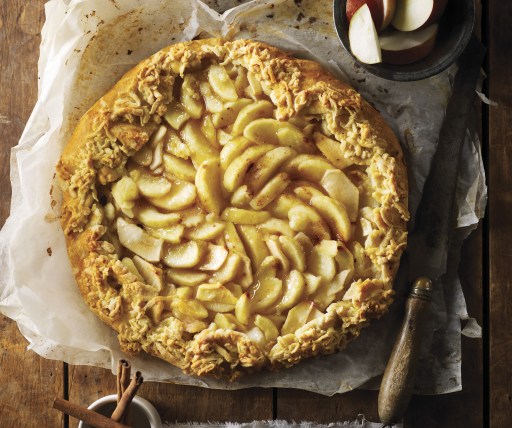
My interview with Goldman was well-timed. A week before Rosh Hashanah, she generously shared two of her most popular holiday recipes, Moist and Majestic New Year’s Honey Cake and Shofar Apple Tart.
Goldman has been baking since she was seven or eight years old, she said in a telephone interview from her home in Montreal. “I was so intrigued by the challenge…Baking ignited a passion that has stayed with me.”
Macy Goldman
She graduated from McGill University with a degree in English literature, but followed her passion and went on to get a pastry chef diploma from the prestigious l’Hotellerie et Tourisme du Quebec in Montreal.
Before earning the accreditation, Goldman started her baking career as an independent specialty cake supplier for cafes and restaurants. “I was baking at home, hawking carrot and cheesecakes,” she recalled.
She even rented a bakery for a time, but said the work was not sustainable once she became pregnant. That’s when she went back to school.
She said wanted to become a food journalist, a career she launched with a story about Montreal bagels for the New York Times. That article led to host of assignments for prestigious U.S. and Canadian publications, such as The Washington Post, Bon Appétit Magazine, Food and Wine, the Chicago Tribune, Los Angeles Times, and the Montreal Gazette.
Goldman started her popular Web site, BetterBaking.com, in 1997. A year later A Treasury of Jewish Holiday Baking was published by Doubleday.
Her Caramel Matzah Crunch was lauded as “legendary” by the late food maven, Norene Gilletz.
Goldman has since written 10 other cookbooks. Her latest, The Newish Jewish Cookbook, was published in 2019. This collection of traditional Jewish recipes can be purchased on Amazon or Betterbaking.com. All her cookbooks are available as digital editions.
Goldman said her recipe for Majestic New Years Honey Cake below took years to perfect. It’s “extra moist and sweet and as good on the day of baking as it is days later. In fact, it’s even better as it ages. I went through many variations and tasting sessions until I was satisfied with this definitive cake.”
To round off holiday desserts I was given a recipe for komish from Pamela Permack. Komish, Permack’s signature dessert, is similar to mandelbrot, or Jewish biscotti.
Permack made a batch of komish for her grandson’s (my great nephew’s) bris. She gave me the leftovers as well as her recipe.
MOIST AND MAJESTIC NEW YEAR’S HONEY CAKE
3½ cups (875 ml) all-purpose flour 1 tbsp (30 ml) baking powder 1 tsp (5 ml) baking soda ½ tsp (2 ml) salt 1 tbsp (15 ml) cinnamon ½ tsp (2 ml) cloves ¼ tsp (1 ml) allspice 1 cup (250 ml) oil 1 cup (250 ml) honey 1½ (375 ml) cups white sugar ½ cup (125 ml) brown sugar 3 eggs 1 tsp (5 ml) pure vanilla extract 1 cup (250 ml) warm coffee or strong tea 3/4 cup (375 ml) orange juice ¼ cup (60 ml) rye or whisky* ½ cup (125 ml) slivered or sliced almonds, optional
*If you prefer not to use whisky, replace it with orange juice or coffee.
Preheat the oven to 350°F (180°C). Line the bottom and sides of a 10-inch (15-cm) angel-food cake pan with lightly greased parchment paper, cut to fit. Stack two baking sheets together and line the top one with parchment paper. Place the cake pan on that (this prevents the bottom from browning too quickly).
In a large bowl or large food processor, blend the flour, baking powder, baking soda, salt, cinnamon, cloves and allspice. Make a well in the centre, and add the oil, honey, white and brown sugars, eggs, vanilla, coffee, orange juice and rye or whisky. Blend well, making sure that no ingredients are stuck to the bottom. This is a thin batter.
Spoon the batter into the prepared pan and sprinkle the top of the cake evenly with almonds. Place the cake pan on the baking sheet.
Bake in the prepared oven for 55–65 minutes, or/ and until the cake tests done, that is, it springs back when you gently touch the cake centre. If the cake seems done but still seems a bit wobbly in the centre, lower the oven temperature and give it 10–20 more minutes. It is very important to give the cake the proper amount of baking time.
Let the cake stand 15 minutes before removing it from the pan. Makes 8–10 servings
SHOFAR APPLE TART
Pastry Dough
2 cups (500 ml) all purpose flour 1 tbsp (15 ml) sugar ½ tsp (2 ml) salt, 6 oz (200 ml) unsalted butter, shortening *or unsalted margarine, in small chunks, 3–6 tbsp (45-90 ml) cold water
Filling:
5–7 large apples (such as McIntosh or Golden Delicious), peeled, cored, and diced, 2 tbsp (30 ml) unsalted butter or margarine, in small pieces, optional, 3/4 cup (210 ml) sugar 1 tbsp (15 ml) fresh lemon juice ¼ tsp (1 ml) cinnamon Pinch of cloves ¼ cup (60 ml) honey
Egg Wash
1 egg 2 tbsp (30 ml) water sugar for sprinkling
*If using shortening, use half butter flavoured and half neutral
For the dough: In a food processor, mix the flour, sugar and salt. Add the butter (or shortening or margarine) in chunks and pulse to produce a coarse, crumbly mixture. Add the water and pulse to make a mass or shaggy dough about 30–60 seconds, drizzling in a bit more water if required to make dough hold together.
Turn out the dough onto a lightly floured work surface and knead a few seconds. Form into a disk, wrap well and chill for 30–45 minutes.
Prepare apples: Place them in a large bowl and toss them with the sugar and butter.
Prepare egg wash: In a small bowl combine the egg and water, and set aside.
Preheat the oven to 425°F (220°C). Line a baking sheet with parchment paper.
On a lightly floured surface, roll the dough to a 10–12 inch circle. Transfer it to the baking sheet by folding in the quarters and unfolding it onto the baking sheet. Fill the dough with apples to within 2 inches (5 cm) of the edge. Fold this border inwards and press gently onto the fruit. Brush the border with egg wash and sprinkle on the sugar.
Alternatively, use a 12-inch tart or quiche pan and place the dough in the pan and proceed as above for a more refined, less rustic crostata.
Place the tart or crostata on a baking sheet and bake until the apples are oozing juices and the coloured and exposed pastry is medium brown, about 35–50 minutes. Take the tart/crostata out of the oven and drizzle in the honey into the apples.
Serve warm or at room temperature. Can be made a day ahead. Makes 8–10 servings
KOMISH Pamela Permack
3 eggs 1 cup (250 ml) sugar 1 cup (250 ml) oil 1 tsp (5 ml) vanilla 3 cups (750 ml) flour, divided ½ tsp (2 ml) salt 2 tsp (2 ml) baking powder 2 tsp (10 ml) cinnamon 1½ cups (750 ml) chocolate chips Additional oil for brushing
Preheat oven to 375°F (190°C). Line a 9 x 13-inch (18 x 26-cm) baking pan with parchment paper.
Place the eggs, sugar, oil, and vanilla in a large bowl or in a stand mixer. Beat together with an electric hand beater or stand mixer. Incorporate 1 cup (250 ml) flour and beat.
Incorporate by hand the remaining 2 cups (500 ml) flour, salt, baking powder and cinnamon. Add the chocolate chips.
Divide the dough into three logs. Brush the tops with oil and place them in the prepared baking pan. Bake for 20 to 23 minutes in the preheated oven. Remove the logs from the oven. Slice them in 1-inch (2 cm) slices. Turn off the oven and return the slices into the oven for 45 minutes. Makes 24–36 slices.
Orders for Bela’s Bees Raw Honey and beeswax candles can be made online. https://shoresh.ca/
Place orders before Sept. 13 at 8 p.m. and pick up at one of the following locations:
Midtown: Oakwood Village, Sept. 13,12–8 p.m.,132 Cedric Ave. Downtown: Bloorcourt Village, Sept.14, 4–8 p.m., 362 Concord Ave. Downtown: Annex, Sept. 15, 4 Sept.15, 4–8 p.m., 91 Walmer Rd. Forest Hill: Sept. 16, 4–8 p.m., 248 Russell Hill Road
Sept. 16, 11 a.m.:Bernard Betel Cooking Club – Prepare Vegan Chipotle Mac & Cheese with Jen MacDonald https://us02web.zoom.us/meeting/register/tZYocuyupjgtHdH4SkYK9XS69aolga5nsjd_
Sept. 22 2 p.m.: On Lox and Life: The Forward is sponsoring a conversation about all-things-appetizing with Len Berk, the last Jewish lox slicer at Zabar’s, and Melissa Clark, the New York Times food writer and cookbook author. This talk will be moderated by Jodi Rudoren, editor-in-chief of the Forwardhttps://forward.com/culture/452758/september-22-on-lox-and-life/
MONTREAL – Dark since March, the Segal Centre for Performing Arts stage will light up again before the end of the year.
The Segal will present American playwright Glen Berger’s one-man drama Underneath the Lintel in December in its main theatre, marking the opening of a season that is expected to be a mix of live and online programming.
This is a co-production with Theatre du Nouveau Monde (TNM), the Segal’s first collaboration with the venerable Montreal theatre, and the French section of the National Arts Centre in Ottawa.
The downtown TNM presents the play in French translation as Zebrina: Une piece a conviction in September. The same actor, Emmanuel Schwartz, and director, Francois Girard, headline both productions. Girard is a distinguished Quebec cultural figure, best known as the director of such films as The Red Violin, an Academy Award winner, and last year’s Holocaust-themed The Song of Names.
Segal artistic director Lisa Rubin said between about 65 and 95 people can be accommodated in the 300-seat main theatre to comply with Quebec’s physical distancing directives. The exact number at each performance will be based on how many patrons come from the same household and can sit together, she explained.
An online option will also be offered. The dates of the run are still to be determined, but Rubin expects tickets to go on sale in October.
The Segal had to abruptly cut short the last season midway through the musical The Times They are A Changin’ on March 12 when the government banned indoor gatherings of over 250 people. That directive presaged the province’s full-scale lockdown announced two days later.
There were two plays remaining in the 2019-2020 subscription series, including the acclaimed Oslo in its Montreal English-language premiere.
On top of that, Rubin was just about to announce the six-play lineup for the coming season that would have started this fall, which was abandoned due to the uncertainty of the times.
On Aug. 3, the government gave the green light to performance venues to host audiences of up to 250 people, seated at least 1.5 metres apart.
French theatres in Montreal, unlike most English ones in Canada, are mounting new seasons, and that proved fortuitous for the Segal, Rubin said.
There is Jewish content in Underneath the Lintel and TNM’s artistic director Lorraine Pintal contacted the Segal for guidance on handling it.
Since its premiere in 2001 in Los Angeles, Underneath the Lintel has been produced widely, sometimes stirring controversy. The sole character, a Dutch librarian, goes on an international quest to solve the mystery of a travel guide, returned anonymously – 113 years overdue. The legend of the Wandering Jew, commonly viewed as a figment of Christian anti-Semitism, is woven into the unfolding story.
From there quickly grew the idea of staging the play in its original English at the Segal.
The shutdown has been devastating for the Segal and the many people who rely on it for their livelihood, but Rubin assured that its survival is not in jeopardy.
She said over 100 contracts with actors, crew and others involved with the cancelled season had to be broken, and the Segal’s own staff has been reduced to a “small team.”
Federation CJA, of which the Segal is an agency, withdrew its funding, a decision Rubin accepts was necessary in order to reallocate resources to the community’s most pressing needs during the pandemic crisis.
The Segal continues to receive money from the three levels of government, but that amounts to less than $200,000. It has an endowment that will help see it through to better times, said Rubin, but support from donors and patrons is still crucial.
She made clear that the Segal family is not going to bail out the centre.
“Their job is done; they are not going to rescue us. It’s up to the community and our audience now.”
For now, Rubin is focused on getting the Segal physically ready to welcome back its audience after a long “intermission.” Although all safety precautions will be in place, she promises that theatre-going in the age of COVID can be fun.
“This has been devastating for the cultural sector. There is no precedent for what we are going through,” she said. “We are writing our own script for this.”
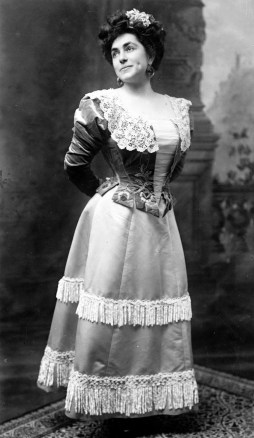
Jewish musicians often changed their first and/or surnames, as did Pauline Lightstone, born in Montreal to Jewish parents who immigrated to Canada from Russia and Poland. Her family name was Lichtenstein.
The soon-to-be Canadian prima donna began singing at an early age. After studying at McGill University’s Royal Victoria College with Clara Lichtenstein (no relation), she received a grant in 1902 from the college’s patron, Donald Smith (Lord Strathcona) to attend the Conservatoire de Paris, where she studied voice with Edmond Duvernoy. Collections Canada notes that she adopted her new stage name, Donalda, to honour her patron.
Pauline Donalda
According to Grove’s Dictionary of Music and Musicians, Donalda’s artistic career burgeoned following a successful 1904 debut singing composer Jules Massenet’s opera Manon in Nice, France. In 1905 she sang the roles of Conception in Maurice Ravel’s L’heure espagnole and Ah-joe in Franco Leoni’s L’Oracolo for Queen Victoria at London’s Covent Garden, and at the Opera de la Monnaie in Brussels. In a Verdi opera, she sang with tenor Enrico Caruso in 1906.
That same year, she sang at the Montreal Arena with her husband, baritone Paul Seveilhac, and then joined the Oscar Hammerstein-founded Manhattan Opera House. But she yearned to return to Europe in 1907 to perform in Paris and London.
But she longed for Canada and chose to remain in Montreal as the First World War began, singing in a variety of music halls and concerts, including appearances in New York and Boston. She organized the Donalda Sunday Afternoon Concerts, with proceeds supporting various war charities.
She married her second husband, Mischa Leon, in 1918, after returning to Paris.
A Museum of Jewish Montreal review noted, “From 1922 on, she devoted herself to teaching voice. Twenty years later, in 1942, she founded the Opera Guild of Montreal, which staged the first Canadian performances of many operas. Among the first women to promote opera, Donalda made an exceptional contribution to the development of the arts in Canada. In so doing, she helped promote both the country and the Jewish community worldwide.”
As president and artistic director of the Opera Guild of Montreal until 1969, Pauline Donalda was named an Officer of the Order of Canada in 1967 “for her contribution to the arts, especially opera, as a singer and founder of the Guild.”
David Eisenstadt
David Eisenstadt is Founding Partner at tcgpr.com and is a graduate of Carleton University’s School of Journalism and the University of Calgary.
MONTREAL—Jewish day school officials here say they have put in place all of the measures required under Quebec’s COVID back-to-school plan, and even exceeded them – but only within the limits of the law.
In an online discussion Aug. 25 organized by the Communaute Sepharade Unifiee du Quebec as part of the annual Festival Sefarad de Montreal, officials offered assurances that their schools are ready to provide a safe environment for students and staff when they open after being closed since mid-March.
The schools are members of the Association of Jewish Day Schools (AJDS), an independent body funded by member schools.
A key point of divergence between some of the Jewish schools and the government’s plan, unveiled on Aug. 10, was the wearing of masks. The plan stipulates that masks must be worn by students in grade 5 and up at all times in the school’s common areas, such as corridors. Wearing them in the classroom, however, is optional.
Some schools had wanted to make masks obligatory in the classroom or for younger children as well, as a few non-Jewish private schools in Montreal said they would. In reaction, the government was firm: That neither private nor public schools have the legal authority to impose measures beyond the public health directives.
The AJDS-affiliated schools, which open as early as Aug. 27, are now “strongly recommending” that students cover their faces while in class.
The discussion, moderated by journalist Elias Levy and conducted in French, heard that some schools have also implemented such extra precautions as Plexiglas shields between desks and air purifiers in classrooms. At least one school will be doing temperature checks.
The Quebec plan does not require social distancing in the classroom. Students in each class are expected to be a “bubble”’ that stays together, with teachers moving between classrooms.
Connecting to the Zoom conference were: AJDS executive director Sidney Benudiz; Lucienne Azoulay, director of Academie Yechiva Yavne; Laura Segall, Hebrew Academy’s head of school; Jennifer Benoualid, principal of Solomon Schechter Academy; Alexandra Obadia, president of Talmud Torah/Herzliah High School; and Esther Krauze, president of Ecole Maimonide.
Another AJDS affiliate, Jewish People’s and Peretz Schools/Bialik High School, which did not take part in the panel, had to retract a message it sent to parents that all students from kindergarten and up would be required to wear masks in class after the government made clear that no school could make such a decision.
Under the province’s plan, all students must go to school fulltime this fall, at least up to grade 9. For the two senior years, schools may opt for a combination of in-school and distance learning, as long as students are in class at least 50 per cent of the time.
The sole exemption is for medical reasons, either the child’s or a member of their household, and that must be certified by a doctor according to strict criteria the government has defined. A group of Quebec parents who want the choice of online learning extended to all students has launched a legal challenge to the government, led by constitutional lawyer Julius Grey.
About 150 doctors and scientists with school-aged kids have also issued an open letter to Premier Francois Legault criticizing the plan as inadequate to protect against the spread of the coronavirus, and urging masks and social distancing in class.
The government has not yielded to this criticism, insisting its plan meets the current advice of health and educational experts, but is open to modification if the situation changes. On Aug. 25, Health Minister Christian Dube described COVID as under control in the province, which now has an average of 80 new cases confirmed daily.
The panelists acknowledged considerable concern exists among their schools’ parents, but the number that have secured exemptions for their children is relatively small.
Benoualid said Solomon Schechter, which is has elementary grades only, has 10 out of an enrolment of 450, while Obadia said Talmud Torah/Herzliah, which has 650 students, has 20 that are exempted.
All of the officials affirmed that their schools are well prepared to provide a full education online to these students, as well as any others who may have to stay home for an extended period, citing the experience they gained this spring.
Benudiz noted that the member schools, under AJDS’s guidance, rallied when they were ordered to close in March to develop distance learning platforms, and quickly put them in place. This combination of real-time instruction by teachers and online materials available proved to be successful, said Benudiz, who applauded the co-operation that continues among the schools.
The schools have now installed cameras in classrooms that will enable students at home to follow along with their peers and even interact.
The schools have closed their cafeterias, and lunches will be eaten in the classroom. The Orthodox schools are using the cafeterias and other repurposed spaces for socially-distanced prayers.
The panelists were definite that their schools would be able to cope well should they have to shut down again due to a second wave of COVID, saying they could pivot within 24 hours to remote instruction.
The other AJDS members are: Akiva School and Hebrew Foundation School, both elementary; and Beth Jacob School, which has elementary and secondary levels.
* A previous version of this story stated that the Association of Jewish Day Schools (AJDS) is a Federation CJA agency. In fact, it is an independent body funded by member schools. The CJR regrets the error.
Comment le Centre Chabad et le Centre Hillel envisagent-ils la rentrée universitaire 2020-2021 à l’Université de Montréal (UdeM) ? Appréhendent-ils ce retour en classe qui se déroulera cette année sous le sceau de l’exceptionnalité ?
Le Centre Hillel a été pendant trente ans le principal foyer et lieu de rencontre des étudiants juifs francophones de Montréal.
Cette institution s’est notoirement distinguée par son dynamisme, son souci permanent de défendre la cause d’Israël sur les campus universitaires francophones de Montréal et la qualité de ses programmes culturels et sociorécréatifs.
Le Centre Hillel a fermé ses portes en 2014.
La bâtisse qui l’a abrité pendant trois décennies, sise au 5325, rue Gatineau (au coin de la rue Jean-Brillant), était depuis 1984 la propriété de la Fédération CJA.
Le Centre Chabad de l’Université de l’UdeM, fondé en 2014 par le Rabbin Shlomo Banon et son épouse, Matti, a acquis celle-ci en septembre 2019 pour la somme de 605 000$. Un prix bien en dessous de sa valeur monétaire réelle, estimée à environ 900 000$, dans un marché immobilier en pleine effervescence.
À l’instar du Centre Hillel, le Centre Chabad est reconnu aussi comme un groupe affilié à l’UdeM.
Il a entrepris récemment une campagne de financement. Objectif : 400 000$, qui serviront à défrayer les coûts de rénovation d’une bâtisse vétuste dont la structure est en très mauvais état.
Des rénovations majeures sont urgentes: la toiture en déliquescence a été réparée, l’aménagement intérieur requiert d’importants travaux de construction, six dortoirs, qui hébergeront des étudiants, seront aménagés…
« La Fédération CJA de Montréal a été très réceptive à notre ardent souhait d’acquérir l’immeuble qui a abrité jadis le Centre Hillel. Cette institution fédérative a compris l’importance de recréer un foyer pour les étudiants juifs de l’UdeM situé à proximité de cette institution universitaire. Nous considérons notre engagement dans cette noble cause communautaire comme une Mitzvah. Beaucoup d’étudiants juifs de l’UdeM, particulièrement ceux venant de l’étranger, se sentent souvent seuls. Le Centre Chabad est pour eux un foyer et un repère identitaire fort. Notre philosophie est basée sur l’adage « A home away from home » (« Une maison loin de la maison »). Nous voulons que les étudiants de l’étranger que nous accueillons se sentent comme chez eux », explique en entrevue le Rabbin Shlomo Banon, fondateur et directeur du Centre Chabad de l’UdeM.
En pleine pandémie de la COVID-19, le retour en classe pose un sérieux casse-tête aux administrateurs des écoles, des cégeps et des universités. Les différentes facultés de l’UdeM ont prévu un enseignement hybride : quelques cours seulement seront donnés en classe, la majorité seront dispensés en ligne.
Cette réalité incontournable ne risque-t-elle pas d’avoir cet automne une incidence négative sur la fréquentation du Centre Chabad de l’UdeM?
« Au contraire. La pire chose pour la santé mentale d’un étudiant est de passer la journée entière chez lui. Nous l’avons vu récemment. Le confinement a provoqué de grands ravages, particulièrement au niveau émotionnel et psychologique. Le Centre Chabad de l’UdeM sera une vraie bouffée d’oxygène pour des étudiants astreints à suivre leurs cours universitaires depuis leur domicile. Nous allons aménager l’espace de nos lieux en appliquant d’une manière pointilleuse toutes les directives émises par les autorités de santé publique du Québec : mesures d’hygiène, distanciation sociale de deux mètres… Nous serons en mesure d’accueillir quotidiennement 40 à 60 étudiants tout en respectant rigoureusement les mesures sanitaires recommandées. Ces jeunes pourront étudier dans un cadre sécuritaire, chaleureux et convivial tout en bénéficiant de repas savoureux casher proposés par notre cafétéria et d’un réseau Wifi superpuissant », précise le Rabbin Shlomo Banon.
Combien d’étudiants juifs fréquentent l’UdeM?
« D’après les données établies en 2018 par le Centre consultatif des relations juives et israéliennes (CIJA): 850. Un bon nombre d’entre eux sont des étudiants étrangers majoritairement originaires de France. Il y a aussi des Belges, des Suisses et des Marocains. Mais chaque année, il y a de plus en plus d’étudiants ashkénazes anglophones qui poursuivent leurs études dans les facultés de droit et de médecine de l’UdeM. J’estime que cette année environ 1000 étudiants juifs fréquenteront cette université francophone », souligne le Rabbin Shlomo Banon.
Le Centre Hillel est-il toujours actif sur le campus de l’UdeM?
« Absolument. Bien que la branche du Centre Hillel fasse désormais partie intégrante du Hillel Center localisé au centre-ville de Montréal, nous continuons à être présents dans les principaux campus francophones, et particulièrement à l’UdeM. Force est de reconnaître que le début de cette nouvelle année universitaire s’annonce un peu plus compliquée, la majorité des cours devant être dispensés en ligne. En temps normal, nous tenons des tables d’information et organisons des conférences sur le campus. Cependant, nous n’allons pas chômer pour autant. Nous comptons offrir des activités virtuelles, par exemple une rencontre chaque semaine avec un invité de marque », nous a dit Sol Felsztyna, étudiante en éducation à l’UdeM et coprésidente du Centre Hillel dans cette université.
Y a-t-il une rivalité entre le Chabad et le Centre Hillel à l’UdeM?
« Pas du tout. Il n’y a aucune rivalité mais une complémentarité, répond sur un ton rassurant Jordan Ohana, étudiant en comptabilité à l’École des HEC et coprésident du Centre Hillel de l’UdeM. Le Centre Chabad dessert essentiellement les étudiants juifs francophones de l’étranger poursuivant leurs études à l’UdeM. Il leur offre divers services, notamment religieux et sociaux. Nous souhaitons collaborer étroitement avec le Chabad afin de proposer des activités conjointes aux étudiants juifs de l’UdeM. L’union de nos forces vives sera certainement un grand atout pour nos deux institutions. »
La défense d’Israël sur le campus de l’UdeM est-elle une priorité pour le Chabad et le Centre Hillel?
Alexandre Ohayon, étudiant en économie à l’UdeM et président de la branche du Chabad dans cette université, Sol Felsztyna et Jordan Ohana, coprésidents du Centre Hillel de l’UdeM, sont foncièrement d’accord sur un point : les aspects les plus hideux du conflit israélo-palestinien n’ont pas été importés sur le campus de l’UdeM. Les relations entre étudiants juifs et musulmans dans cette université sont respectueuses et harmonieuses. L’atmosphère est tout autre que celle qui règne dans les campus de l’Université Concordia et de l’Université McGill. Les frictions sont très rares, même pendant la Semaine de l’apartheid israélien organisée annuellement par les étudiants propalestiniens.
« Le Chabad de l’UdeM est très sensible à la question de l’antisémitisme et du BDS, campagne de boycott, de désinvestissements économiques et de sanctions prônés par les détracteurs d’Israël. Nous voulons éviter à tout prix les confrontations. La vocation du Centre Chabad est essentiellement spirituelle. Mais nous sommes pro-Israël et contre le BDS à 1000%. Nous tablons plutôt sur un dialogue constructif. Nous sensibilisons les étudiants juifs à la question de l’antisémitisme et de l’antisionisme. Nous les encourageons à répondre aux critiques d’Israël avec des arguments fondés et sensés rappelant la légitimité de l’État juif et la justesse de sa cause plutôt qu’en brandissant des drapeaux d’Israël. Nous militons en faveur d’Israël d’une manière intelligente et pacifique. »
Sol Felsztyna abonde dans le même sens.
« Il n’a jamais été question de capituler face à la propagande palestinienne. Par contre, nous nous escrimons à rappeler aux étudiants non-juifs, susceptibles d’être séduits par la rhétorique propalestinienne trompeuse, qu’Israël ne se limite pas à une armée et à des soldats combattant des terroristes palestiniens. Israël, c’est aussi une démocratie vibrante, une société très créative, une économie très performante, portée par le high-tech, une littérature et un cinéma qui rayonnent dans le monde entier… Nous voulons promouvoir dans les campus une image positive, et non réactive, d’Israël. Une image autre que politique ou militaire de ce petit pays remarquable: ses réalisations gigantesques dans les domaines des sciences, de la médecine, de l’agriculture, des arts, de la littérature, du cinéma… Les étudiants non-juifs apprécient beaucoup plus ces facettes, malheureusement fort méconnues, d’Israël. »
MONTREAL—The bold, red sign looming over St. Laurent Boulevard that immortalized a poor Romanian-Jewish immigrant for generations will soon disappear with the closure of the eponymous Moishes restaurant, which has been at the same location since it opened in 1938.
The landmark is one of Montreal’s oldest and most famous dining establishments.
A casualty of the pandemic and possibly the vision of the upscale steakhouse’s new owners, Moishes will rise again someday, somewhere, promises its manager Lenny Lighter, son of Moishe. But if it does, the restaurant’s legion of devotees know it will never be the same.
Lighter and his brother Larry, who took over the eatery from their father, sold Moishes to the Sportscene group, a company that most notably owns the Cage aux Sports chain of resto-bars, in December 2018. Lenny stayed on as manager.
Like all restaurants, Moishes had been closed since March when the province went into lockdown. The Quebec government gave Montreal restaurants the green light to reopen on June 22, and patrons grew nervous as the weeks passed but no word came on when they could sink their teeth again into one of Moishes’ “charbroiled, dry-aged” strip loins, with sides like chopped liver and matzoh ball soup.
On July 8, a website post revealed that the owners were “still evaluating our options,” but the tone was upbeat. Then, this month, Lighter made known that Moishes was “on hiatus” indefinitely. Although it had not been public, Moishes’ lease was expiring at the end of this year and the owners had concrete plans to move the restaurant downtown, to Victoria Square.
Lighter explained the move would breathe new life into the venerable institution; moving it closer to offices and hotels, where it would attract more workers and tourists.
Sportscene was about to make a $5 million investment in the new premises and construction was set to begin Aug. 1, Lighter said, but when COVID hit and the restaurant industry went into a tailspin, it was felt it “would not make sense” to go ahead with the project.
Lighter said the “intent” remains that Moishes returns, but that will depend on the course of the pandemic and the economy.
According to legend, Moishe Lighter, who immigrated to Montreal in the 1920s, was a busboy who won the restaurant in a poker game. It was originally called Romanian Paradise, and was situated in the heart of the immigrant Jewish district, now known as the Plateau Mont-Royal.
The name was changed to Moishe’s around the beginning of the Second World War (the apostrophe was dropped in the 1970s to conform to Bill 101, Quebec’s French language charter.)
In its early decades, the clientele was largely Jewish. Traditional Eastern European fare was kept on the menu right up to the present day, although there was no pretense of being “kosher style,” as shrimp cocktail and lobster rolls were gradually added.
Also preserved over the decades was the ambience. Moishes was upstairs, removed from the bustle of the gritty “Main.” Patrons entered an elegant Old World dining room, with chandeliers and starched white table linen, subdued lighting, and hushed tones. Formally attired waiters were attentive but discreet. Many of the staff worked there for decades; at least one server clocked over 50 years. And Lenny and/or Larry were always on site seeing that diners were happy.
Their father’s black-and-white photo remained the logo, over the cursive Moishes signature.
For certain families, Friday night Shabbat dinner at Moishes was a long-running tradition. Eiran Harris, a volunteer in the Jewish Public Library archives for many years, said he made sure to conserve an old menu someone donated to its holdings because he recognized that the restaurant was a piece of Montreal Jewish history.
Plenty of celebrities ate there over that history: Hollywood actors, sports personalities, politicians. A Polish cardinal named Karol Wojtyla reportedly had a satisfying meal under Lighter’s watch during a Canadian visit in 1969. Wojtyla later became Pope John Paul II.
In 2012, Forbes magazine rated Moishes among the top 10 steakhouses in the world, just one of the numerous accolades the restaurant has received from the media and industry.
Writer Mordecai Richler was a frequent patron, apparently drawn as much to the Scotch as the steak. He made oblique references to a Moishes-like eatery in his novels.
Troubadour Leonard Cohen also came often when he was in town. Cohen, who died in 2016, maintained a home nearby.
Lighter recalled that Cohen, whom he considered a friend, preferred the lamb chops, accompanied by a red Bordeaux.
This was borne out with the posthumous publication in 2018 of The Flame, a collection of Cohen’s previously unpublished poems and lyrics that he had compiled as a final work. One of the pieces, entitled “Lambchops,” dated 2006, opens with the lines: “Thinking of those lambchops of Moishe’s the other night.” Fittingly, his family held a wake for Cohen at Moishes.
Moishes’ heyday was probably in the 1970s when expense accounts received little scrutiny, liquid lunches were de rigueur, and red meat was considered healthy.
Retired accountant turned thriller writer Robert Landori recalled that for several years, he took the manager of his bank to Moishes at least once a week mid-day.
“He was an aficionado of steak and Scotch – always two, and then back to work. What I remember most is our waiter; he knew everybody, he remembered what we ate and drank, how I liked my steak. We won’t see the like of Moishes again.”
MONTREAL – The Museum of Jewish Montreal (MJM), evicted from its premises in June, has resumed some of its popular walking tours through historic Jewish neighbourhoods, keeping alive its real-life presence while it assesses its future.
Led by trained guides, the family-friendly tours focus on little-known stories about Jewish life and intriguing personalities in the Plateau Mont-Royal and Mile End districts of yesteryear. COVID precautions are observed: Everyone must wear a mask and keep a safe distance.
Founder and executive director Zev Moses says MJM is using the “shocking” loss of its physical location as a time to review its mission, and he is “cautiously optimistic” MJM will have a new home by next year.
Since 2016, MJM had occupied a street-level storefront at the corner of St. Laurent Boulevard and Duluth Street, in the heart of what had been the Jewish immigrant district, and today’s trendy Plateau. The former industrial building was originally the Vineberg garment factory, dating to 1912.
MJM was preparing to reopen after being locked down since mid-March, when it received notice in May from a new landlord that the space was going to be leased to another tenant and that the museum would have to vacate by June 30, Moses said.
The timing was especially painful because MJM, which began as a virtual conception, was looking forward to its 10th anniversary celebration this year.
“We hope to have (a new place) by next spring, there’s a good possibility, but it will depend on where the pandemic and economy goes,” he said.
Moses, a rabbi’s son who holds a master’s degree in urban planning from the University of Pennsylvania, started MJM as an online portal where users could connect to Montreal Jewish history and culture interactively. Its signature feature was “mapping” key Jewish sites and linking them to people and events. The site also archives personal stories of the Montreal Jewish past.
In a reversal of the societal direction, Moses expanded into bricks and mortar, a gamble he said paid off and allowed MJM to reach a far broader audience, both in the Jewish community and general population.
Despite the name, MJM was never strictly a “museum,” and only in the past few years has been holding exhibitions by independent Canadian Jewish artists and rescuing artifacts of disappearing Jewish landmarks, like shop signs.
Rather, Moses conceived of MJM as a hub where Jews of all ages and identities could gather, and non-Jews would feel comfortable dropping in and learning a little about what Jews are all about.
Moses was particularly keen to showcase the diversity of the Montreal Jewish community and how it is an integral part of the city’s history and character.
A big draw was Fletcher’s, the food counter where modern twists on various ethnic Jewish cuisines could be sampled, as well as musical programs – typically informal klezmer performances by young artists. MJM strived to be a good neighbour, taking part in the Plateau’s festivals and forming ties with area community groups.
Moses said MJM was especially successful in attracting Jews under age 35 who might otherwise not be involved with community life, and in changing ill-informed images about Jews among Quebecers.
“It really had become a second home for many,” he said. So much so, that at about 1,200 square feet, including office space, MJM’s location was getting too small anyway, said Moses.
Those are his prime selling points as he seeks support for MJM’s continuation.
“If there is a silver lining, this has given us time to re-conceive what we will look like post-pandemic,” he said.
The walking tours, now in their ninth season, have been a major source of income, but with tourism down drastically, it would not have made sense to run the usual schedule this season, Moses noted, even if MJM was still open. Nevertheless, he felt it worthwhile to offer a limited number and is pleased to see Montrealers joining them.
“Why not take a walk with an expert and learn something you didn’t know about your city?” he asked. “These neighbourhoods today are very popular with students and families, but most don’t know the stories that are hidden in their own backyards.”
Three different tours are available, scheduled Tuesdays through Sundays. Bookings may be made at [email protected].
“’Bubble tours” are also offered for private groups of up to eight family members or friends. In the coming months, MJM plans to launch virtual tours as well. Meanwhile, a variety of online programming is set to resume, after a summer break, at the end of August.
Between 55-60 percent of MJM’s revenue has come from private donors, perhaps six to seven percent of that from Federation CJA or the Jewish Community Foundation of Montreal, Moses said.
About 30 per cent was self-generating through rentals of the space, ticket sales, and the food counter’s receipts. The rest was government funding.
Moses said all nine permanent staff members have been retained, but in the summer, the number employed normally swells to about 30.
MONTREAL—Those given to black humour may joke that Gary Perlman has spent more time in cemeteries than some of their denizens.
But the retired software developer is deadly serious in his quest to photograph as many gravestones in Montreal-area Jewish burial grounds as he possibly can, and to research each person who lies beneath.
Over the past five years, Perlman has photographed more than 40,000 stones, some dating back to the early 19th century, finding ingenious ways to make legible often worn or damaged inscriptions, or to illuminate those in obscurity.
Gary Perlman
He has submitted these high-quality images, along with records about the deceased he has organized, had translated from Hebrew, and frequently added to or corrected – a total of over 100,000 items – to JOWBR, the JewishGen Online Worldwide Burial Registry.
JOWBR catalogues data on Jewish cemeteries around the world and makes it available in searchable format to genealogists and other researchers everywhere, free of charge.
Perlman, who has done all this without remuneration, was already a hero to his fellow members of the Jewish Genealogical Society of Montreal (JGS-M). Now, he’s being recognized around the globe. This month, the modest Perlman received the 2020 Volunteer of the Year award from the International Association of Jewish Genealogical Societies (IAJGS), an umbrella organization of over 50 groups. Due to the pandemic, its 40th annual conference was held virtually.
“It’s meaningful that people appreciate what I am doing,” said Perlman, who carries on his sleuthing and hopes the honour will convince reluctant Montreal Jewish cemeteries to give him permission to shoot there as well and add to JOWBR’s Montreal holdings.
A glaring omission is two of the city’s oldest and largest synagogues: Congregation Shaar Hashomayim and Temple Emanu-El-Beth Sholom. Perlman has worked in Canada’s oldest Jewish congregation’s cemetery, the Spanish and Portuguese Synagogue, founded more than 250 years ago.
He has completed documentation of two other historic sites: the Baron de Hirsch Cemetery, Montreal’s largest Jewish cemetery, opened in 1905, and its affiliated Back River Memorial Gardens, dating to the late 1800s. The latter, located in the Ahuntsic-Cartierville borough far from today’s Jewish population, was especially challenging due to its having been left to deteriorate for a long time before a restoration.
Many of its nearly 7,000 stones were crumbling but Perlman managed to capture high-resolution pictures of all of them. Through countless hours of trial and error, he has discovered just the right angle or time of day to coax out eroded epitaphs that were thought to have been lost forever.
He has done all the city’s Holocaust memorials (1,900-plus names) and war casualty monuments (some 600 names), including from the Jewish section of the National Field of Honour in Pointe-Claire, which are posted on JewishGen’s memorial plaque page.
Balancing respect for privacy with the imperative to preserve and share the unique and rich source of Jewish history the burial data represent is a guiding principle for Perlman.
JOWBR, which logs 3.7 million photos and records from 8,666 cemeteries in 130 countries, considers the work Perlman does a mitzvah.
This treasure trove, however, is of little use and can be downright misleading when there are errors, and Perlman found an astonishing number of those even in such basic information as names and dates on both the stones and in the cemeteries’ archives.
A 63-year-old Montreal native, Perlman spent his 30-year career in the United States after receiving a PhD at the University of California at San Diego. He is a late-blooming amateur genealogist, not having done much snooping into his own ancestors until he attended one of the JGS-M’s free workshops for beginners.
He found in its enthusiastic president, Stanley Diamond – also co-founder and executive director of Jewish Records Indexing-Poland, a pioneering digitizer and democratizer of genealogical data – a kindred spirit who recognized modern technology’s power to unlock the past.
Perlman became JGS-M’s webmaster and set about to update the society’s existing cemetery indexing project, which since 2007, had collected a few thousand photos, many of which weren’t good enough for optimal reproduction online.
Perlman does not find spending so much time among the dead morbid. “Not at all!” he replied when asked if it has made him reflect on his own mortality. But on his early expeditions, he did find heartbreaking the tragic tales some stones told, such as the mother and her two children killed in a plane crash who rest together, or the mass unmarked grave of children who died in epidemics.
He couldn’t fail to notice the increased number of burials since the COVID pandemic, which has touched him personally. Another of his volunteer endeavours has been helping elderly residents of the Maimonides Geriatric Centre put together their family trees. He lost three of his “clients” to COVID.
Intriguing and sometimes humorous epitaphs have lightened his days in the field. He has numerous examples, such as the double monument of a couple. On her side it reads: “Saul would rather be golfing.”
Then there was “Don’t forget the Bubba” or “Resting in peace, no conversation please” that made him chuckle.
The IAJGS also cited Perlman for directly linking JOWBR search results to the JGS-M website (jgs-montreal.org) where supplemental information, like parents’ names (including the Hebrew ones) can be found, as well as the location and condition of the grave. He is lauded for creating the JewishGen Dashboard, where users can search some 50 databases from a single web page on the JGS-M site.
Perlman was nominated for Volunteer of the Year by Diamond, and “strongly endorsed” by JOWBR coordinator Nolan Altman who praised Perlman’s “unending attention to detail. His submissions to JOWBR are always clear, complete and precise…When Gary submits data/photos I know it will be correct.”
Wrote Diamond to the IAJGS, “I treasure volunteers who, not only step forward when asked, but who carry out their task with passion and devotion…Gary is most certainly one of the best in this regard.”
MONTREAL—Reading Rabbi Adin Steinsaltz’s popular work on Kabbalah, The Thirteen Petalled Rose, not only changed Murray Dalfen’s relationship to Judaism, but led to a treasured friendship with the author that lasted three decades until the eminent scholar’s death this month.
Dalfen, head of a major North American commercial real estate company, described his awe at the late rabbi’s intellect, astonishing capacity for work, and genuine love of people at a virtual tribute to Rabbi Steinsaltz held by Chabad of Westmount on Aug. 9.
Rabbi Steinsaltz, best known for his monumental lifelong project of translating the entire Babylonian Talmud into modern Hebrew, making it more accessible even to the lay person, died in his native Jerusalem on Aug. 7 at age 83.
Rabbi Adin Steinsaltz
He visited Chabad of Westmount on three occasions, most recently in 2013, giving memorable lectures and leading joyous farbrengen (gatherings) each time, said the centre’s director, Rabbi Yossi Shanowitz.
“He had a profound impact on everyone there, people from all walks of life,” Rabbi Shanowitz recalled. “He took lofty concepts and communicated them to people of all levels, getting to the essence of the matter.”
Born into a secular family and later trained as a scientist, Rabbi Steinsaltz became religious as a youth and was affiliated with the Chabad-Lubavitch community.
Dalfen, a leading benefactor of Chabad of Westmount, said that after reading The Thirteen Petalled Rose, first published in 1989, he was determined to meet its author. The slim volume, which aimed to make esoteric Jewish mysticism intelligible and relevant, was life-altering for Dalfen.
Getting a personal audience with this towering sage was not so simple, but Dalfen managed to meet Rabbi Steinsaltz in Israel. He would visit him there numerous times over the ensuing years. “I find it unbelievable that I was able to know him for 25 or 30 years on a close level.”
Dalfen later sponsored and raised money for the publication of several of the rabbi’s many books, including one of the more than 40 volumes of the translated Talmud.
Dalfen provided some insights: “He was not humble, but was approachable. He had strong opinions and expressed them.” But he was also kind and had a great sense of humour.
Rabbi Steinsaltz had an “extraordinary memory and knowledge, it was limitless,” and even a stroke in 2016 that robbed him of his speech did not impede his ability to think and continue to write, Dalfen recounted.
Rabbi Adin Steinsaltz
Whenever he was in Jerusalem, Dalfen was sure to find a seat opposite Rabbi Steinsaltz at the shul he attended near the Kotel. What surprised him is how the rabbi would reach out to everyone there, even interrupting prayers to speak to someone who needed him.
“I only saw him lose his temper once,” Dalfen recalled. “It was at my home. Someone criticized one of his books on the Talmud. That person got quiet quickly.”
He recalled a bit of wisdom the rabbi imparted once when they were walking the streets of Westmount. “He said: ‘If one changes their direction even one degree, one ends at a different destination.’”
Chabad of Westmount Rebbetzin Devorah Shanowitz, who emceed the tribute, also had an indirect connection to Rabbi Steinsaltz: They shared a sister-in-law. Prior to the Zoom event, Shanowitz spoke to her to gain a glimpse into the man, whom she called “the Rashi of his generation,” whose work will endure forever.
Observing that his impact was felt beyond the Jewish world, Shanowitz cited Time magazine’s description of Rabbi Steinsaltz as “a once in a millennium” figure.
The tribute heard that he never went to bed before three or four in the morning because he was so engrossed in study and writing, despite health challenges he had for years. Yet at the end of his life, Rabbi Steinsaltz regretted that he had accomplished only a fraction of what he had wanted in unlocking seminal Jewish texts for the benefit of all.
Shanowitz also learned that Rabbi Steinsaltz, on a visit to Eastern Europe, was made aware of the existence of a grave of an ancestor. Time was limited and he was scheduled to speak to a group of young people. “He vacillated, but decided the living take precedence and forwent going to the cemetery.”
Connecting with young people was important for him. Shanowitz related that years ago, he was disappointed and a little angry that only a handful of students showed up for a lecture he was to give in Minnesota because it conflicted with final exams.
Long after, Rabbi Steinsaltz was approached at the Kotel one day by a young man. “He told him he had been among those few students [who attended the lecture] and that hearing Rabbi Steinsaltz had transformed his life, and that is why he was there (praying).”
The tribute concluded with an excerpt from a conversation between Rabbi Steinsaltz and Dalfen during the 2013 visit to Chabad of Westmount. Dalfen asked what the mood in Israel was during that violent and turbulent period. “Do you want to hear propaganda or the truth?” Rabbi Steinsaltz answered without missing a beat.
A Conversation with Rabbi Steinsaltz and Murray Dalfen
Click for video: A Conversation with Rabbi Steinsaltz
Rabbi Adin Even Yisrael Steinsaltz sat down for a conversation at Chabad of Westmount in Montreal, Canada. In this frank and informal discussion, he talks about politics, love, family, and more with Murray Dalfen.
The content in this video is produced by Chabad.org, and is copyrighted by the author and/or Chabad.org.
MONTREAL—Declaring that the COVID pandemic poses a “possibly existential threat to Jewish life as we know it,” Federation CJA here will try to raise $100 million over the next two years to meet the immediate needs of community members most negatively affected and to ensure the long-term survival of needed institutions.
The Community Recovery Campaign, launched virtually on July 23, replaces the traditional fall Combined Jewish Appeal, now in its 103rd year. It is co-chaired by prominent businessmen Mitch Garber and Jonathan Wener, who stressed that the 90,000-member community now faces its worst crisis in generations.
The Federation estimates 3,000-5,000 Montreal Jews have become “newly vulnerable”’ due to loss of employment or business and economic hardship exacerbated by social problems, and will need community support. These people are in addition to the approximately 18,000 who were already receiving some kind of relief before the pandemic, Federation says.
Garber said there are families who cannot make their mortgage or rent payments, let alone continue to send their children to Jewish day schools or maintain synagogue memberships.
Wener, a veteran community leader, commented on the economic fallout and human toll of the pandemic: “I have never seen such carnage in my lifetime,” he said. “This is our community’s greatest challenge in living memory.”
Demand for low-cost housing alone is up by 400 percent, says the Federation, which has recently opened a subsidized apartment building. The psychological stress of the ongoing health crisis is evident in increased domestic violence and addiction the Federation’s agencies are seeing.
Federation estimates that 300 Montreal Jewish community members have died from COVID, and a moment of silence was held for them during the launch of the Community Recovery Campaign.
The Federation has cut its own expenses in order to re-allocate resources to where they are most needed, said CEO Yair Szlak. Its staff has been reduced by 30 percent through layoffs and attrition. Remaining staff have had their salaries reduced, with senior management seeing cuts at a higher percentage, Szlak said.
The net result is a reduction in human resources expenses of more than 60 percent. Other costs have been trimmed by close to 70 percent, he said.
Its dozen agencies have also slashed their overhead, and Federation is now funding them on a monthly basis, Szlak said. A much “leaner” community apparatus is anticipated for the foreseeable future.
The campaign’s priority is to provide relief to those newly turning to the community over the next 12 to 18 months so they can get back on their feet and not become permanently dependent, said Federation president Gail Adelson-Marcovitz.
“This could mark the beginning of a period of significant decline for the community if we do not act now,” she warned.
A sum of $40 million is earmarked for an emergency fund, with the remaining $60 million sought going to what would have been the general campaign.
The launch’s guest speaker was Bari Weiss, who surprised many when she resigned as a staff opinion writer and editor at The New York Times this month.
In her letter to the paper’s publisher, which she made public, Weiss claimed she had been “bullied” by colleagues during her two years on the job, ostensibly for her pro-Israel views and advocacy against antisemitism, as well as for her unpopular conservatism.
Connecting to the Zoom conference from San Francisco, Weiss said the COVID pandemic should make Jewish communities in North America ponder deeply about what is “essential,” and that may not include the impressive physical structures like those she grew up with in Pittsburgh.
Instead, she suggested, communities should prioritize what ensures a sustainable and full Jewish life for all.
She urged communities to “think audaciously” about what their post-pandemic Jewish life will look like, and perhaps find an example in the early Zionists who took a leap of faith in leaving sometimes comfortable lives in Europe to fulfill an ideal.
“If there is a silver lining, it is that this is an opportunity for tshuvah, for return to what truly matters…to decide what is essential for generations to come,” she said.
Weiss, author of the book How to Fight Anti-Semitism, said her sense of security as a Jew in America was shattered by the murderous attack on the Tree of Life Synagogue, where she had her bat mitzvah.
Now, as an outspoken “public Jew,” Weiss said she is the recipient of criticism “as a Jew” and worse, death threats, but this has only strengthened her conviction to “represent the Jewish people in a way that reflects well on all of us.”
Antisemitism has “intensified” with the pandemic, she said, because “historically, whenever there has been turmoil people look for a villain, and that has almost always been the Jew.”
SAMY ELMAGHRIBI/SALOMON AMZALLAG (April 19, 1922 – March 9, 2008) Singer-Songwriter, Cantor, Poet, Oud Player
July 22, 2020 – By DAVID EISENSTADT
By night, Samy Elmaghribi was dubbed the Moroccan Charles Aznavour – with a pop singer’s global reputation.
By day, he was Salomon Amzallag, the first Moroccan cantor at Montreal’s famed Spanish & Portuguese Synagogue. Known as Shearith Israel, on St. Kevin Street in Montreal since 1960, it’s Canada’s oldest Jewish congregation, established in 1768. Cantor Amzallag served there from 1967 to 1984.
Two cantors have since sung from the Spanish & Portuguese bimah, including Yehuda Abittan and present-day chazzan Daniel Benlolo, who was one of Amzallag’s students.
Amzallag was Benlolo’s mother’s cousin, and so the Montreal synagogue became their family’s new home.
“He’s the inspirational reason I became a chazzan and his shul was where I received my training,” Cantor Benlolo said. “He was a wonderful mentor. Over the years, I have been privileged to serve Sephardic and Ashkenazi congregations in Ottawa, New York, Atlanta and Caracas, to name a few. Two and-a-half years ago, I was pleased to return home to Shearith Israel to work and live in Montréal.”
Amzallag was born in Safi, a city in western Morocco. His family moved to Rabat in 1926. Growing up, he taught himself to play the oud, a short-neck, lute-type pear-shaped string instrument that dates to Assyria.
Early on, young Samy familiarized himself with Arab-Andalusian music, attending the Conservatoire de Music de Casablanca. Starting at age 20, he studied with many of the great Andalusian masters of his time.
Christopher Silver, an assistant professor of Jewish History and Culture at McGill University, has called him “a mid-twentieth century Moroccan superstar.”
“From his debut in 1948 through his professional zenith in 1956, he was a ubiquitous presence on radio and in concert,” Silver wrote in a recent issue of the International Journal of Middle East Studies.
As radio spread across Morocco, Elmaghribi’s live performances on radio and constant playing of his records on air “helped cement his status as the nation’s voice during a formative political moment.”
His popularity spilled over to commercial advertising: Elmaghribi became an official spokesperson for Coca-Cola in Morocco. “His spoken dialogues and musical hooks for the soft drink company were played in heavy rotation on Radio Tangier International over the next several years,” wrote Silver. During this period, he became the sound of brands like Gillette, Palmolive, Canada Dry and Shell Oil.
A popular entertainer, Elmaghribi built a world-wide fan base and reinforced his Arab-Andalusian musical heritage with performances in Caracas, Jerusalem, Los Angeles, Montreal and New York, as well as playing for Moroccan fans in Oujda and Rabat. Listen to his music here.
Yet, he was committed to his cultural roots and to the sacred liturgical genre, said his daughter, Yolande Amzallag, who helped create Fondation Samy Elmaghribi.
Samy Elmaghribi and Cantor Salomon Amzallag “were one and the same person,” Yolande Amzallag told the Morocco World News at the foundation’s 2015 launch, “despite the fact they performed in different settings whose integrity was never challenged by the apparent dichotomy between the sacred and the secular.”
Her father’s allegiance to God was matched by his allegiance to art, she went on, “and he aspired to spiritual elevation both as an artist and as a practicing Jew.”
After he retired, Amzallag moved to Israel and founded Merkaz Piyyut Veshira, a centre for Sephardic music from where, from 1988 to 1994, he was pedagogical director, according to his biography.
He also co-founded and performed with the Israeli Andalusian Orchestra. In 2006, the orchestra won the country’s highest honour, the Israel Prize.
In November 2008, a few months after his death, Elmaghribi was posthumously recognized by Morocco’s King Mohammed VI, who awarded him the Commander of the Order of Ouissam Alaouite medal for Meritorious Service to Morocco.
His wife, Messody Cohen-Amzallag, died in Ashdod on April 5, 2015. The couple’s children created the foundation “to perpetuate their teachings of respect for tradition, openness to others and generosity through the love of music.”
David Eisenstadt
David Eisenstadt is founding partner of tcgpr and is a graduate of Carleton University’s School of Journalism and the University of Calgary.
En 2017, la présentation du documentaire The Ancestral Sin — Le péché ancestral —, réalisé par David Deri, à la télévision israélienne avait suscité un immense tollé.
En 2019, un autre documentaire sulfureux, Ma’abarot — Camps de transit —, œuvre de la réalisatrice Dina Ziv-Riklis, présenté aussi en début de soirée par une chaîne de télévision israélienne à une heure de forte cote d’écoute, a relancé la polémique houleuse, qui s’était atténuée au fil des années, sur la condition des Sépharades dans l’Israël naissant des années 50 et 60.
Ces deux documentaires-chocs, présentés respectivement dans le cadre des éditions 2019 et 2020 du Festival du cinéma israélien de Montréal (FCIM), évoquent les déboires des immigrants sépharades, majoritairement originaires du Maroc, arrivés en Israël à partir de la fin des années 50. Ces derniers furent victimes d’une discrimination éhontée de la part des bureaucrates de l’Agence juive.
Ce chapitre sombre de l’histoire d’Israël a exhumé des réminiscences que beaucoup de Sépharades avaient enfouies. Les deux documentaires les ont fait rejaillir avec force.
Quel est l’état réel du séphardisme dans la société israélienne d’aujourd’hui ? Y a-t-il toujours une « Question sépharade » dans l’Israël de 2020?
Quatre fins connaisseurs de l’histoire mouvementée des Mizrahim d’Israël nous ont livré leurs vues sur cette question épineuse.
Pour le journaliste israélien Daniel Bensimon, soixante-douze ans après la création de l’État d’Israël, force est de constater que la « Question sépharade », que certains pensaient révolue, est toujours vivace.
Ex-éditorialiste au quotidien de gauche, Haaretz, et ancien député du Parti travailliste à la Knesset, Daniel Bensimon est l’auteur de plusieurs livres remarqués sur la société israélienne et les villes de développement du sud d’Israël. Il est le récipiendaire du plus prestigieux prix de journalisme décerné en Israël, le Sokolov Prize, l’équivalent du prix Pulitzer américain.
« Des documentaires tels que The Ancestral Sin et Ma’abarot sont des œuvres décapantes réalisées par des Sépharades de la troisième génération qui s’escriment à réhabiliter l’honneur bafoué de leurs grands-parents et parents par un establishment ashkénaze arrogant qui les méprisait profondément. Ces derniers étaient considérés comme des êtres illettrés provenant d’un monde arabe moyenâgeux. Ces Mizrahim de la troisième génération sont en colère. Ils se battent pour que la cruelle vérité ayant trait à la condition de leurs aînés dans l’Israël des années 50, 60 et 70 soit enfin dévoilée à la nouvelle génération de Sabras. Au Québec, votre devise est « Je me souviens ». Les Sépharades d’Israël ont fait aussi leur aussi cet a », nous a dit Daniel Bensimon au cours d’une conversation à bâtons rompus sur l’identité sépharade dans l’Israël de la deuxième décade du XXIe siècle.
Pour l’écrivain et éducateur Ami Bouganim, le séphardisme israélien a été instrumentalisé à des fins politiques par des politiciens sépharades et ashkénazes en quête de visibilité ou de légitimité.
Né dans la ville portuaire marocaine d’Essaouira (Mogador), cet essayiste, romancier et philosophe, qui vit à Netanya depuis 1970, est l’intellectuel sépharade israélien qui a le mieux retracé le déracinement de la communauté juive marocaine d’Israël qui a fait son Aliya dans les années 50 et 60.
« En Israël, le séphardisme ne sait plus ce qu’il est. Il s’est empêtré dans la controverse orientale, où il a gagné en pugnacité politique ce qu’il a perdu en charme littéraire. Je ne connais pas de définition du séphardisme. Les documentaires The Ancestral Sin et Ma’abarot ont secoué les consciences dans la société israélienne. Mais, en réalité, ces deux documentaires ne nous apprennent rien de nouveau. On a gratté de nouveau les blessures, mais sans éclairer lez zones d’ombre qui perdurent. Toutes les archives sur cette question ont déjà été épluchées par des chercheurs. Regrettablement, ces documentaires ont été exploités par des journalistes et des politiciens à des fins politiques ou idéologiques. »
D’après l’historien israélien Michel Abitbol, en Israël, la « Question sépharade » s’est muée au fil des ans en une « Question sociale ».
Professeur émérite de l’Université hébraïque de Jérusalem (UHJ), ex-directeur de l’Institut Ben-Zvi, affilié à l’UHJ — institution de recherche spécialisée dans l’étude de l’histoire des communautés sépharades et orientales — et ancien directeur pédagogique auprès du ministère de l’Éducation d’Israël, Michel Abitbol est un spécialiste reconnu de l’histoire du judaïsme marocain, des Juifs du monde arabe et du conflit israélo-arabe.
« En Israël, les Sépharades reviennent de très loin. Depuis les années 50, ils ont accompli des progrès énormes sur les plans social et politique. Ils se sont frayés une place des plus honorables dans les principaux secteurs de la société israélienne: la politique —un bon nombre de députés de la Knesset sont Sépharades—, les affaires, l’armée — de nombreux hauts gradés de Tsahal, dont plusieurs chefs d’État-major, sont d’origine sépharade —, la culture, les arts, la musique, la gastronomie… Aujourd’hui, l’enjeu majeur n’est plus la séphardité mais les inégalités sociales de plus en plus criantes dans l’Israël de 2020, souligne-t-il. Ces écarts sociaux accentuent la pauvreté et la paupérisation des couches sociales les plus vulnérables, particulièrement dans les villes de développement du Sud d’Israël peuplées majoritairement de Sépharades originaires du Maroc. Il est vrai par contre que des écarts entre Sépharades et Ashkénazes perdurent aux niveaux scolaire et universitaire, par exemple en ce qui a trait au nombre de bacheliers et de diplômés universitaires de deuxième et troisième cycles. Mais, on ne peut plus parler, comme c’était le cas dans les années 50 et 60, d’un racisme systémique institutionnalisé à l’encontre des communautés sépharades. »
Le tiers du nouveau gouvernement d’union nationale dirigé par Benyamin Netanyahou, soit dix ministres, est composé de Sépharades d’origine marocaine.
Selon le célèbre historien israélien Tom Segev, qui consacre dans son dernier livre — A State at Any Cost. The Life of David Ben-Gurion (Farar, Straus and Giroux Publisher, New York, 2019) — des pages passionnantes aux relations tendues qui ont toujours prévalu entre le père fondateur de l’État d’Israël, David Ben Gourion, et les communautés orientales, bien qu’elle soit moins aiguë que dans les années 60, 70 et 80, la « Question sépharade » subsiste toujours en Israël.
« Soixante-douze ans après la fondation d’Israël, la « Question sépharade » n’a pas encore été résolue. Nous le constatons aujourd’hui dans l’attitude raciste adoptée par beaucoup d’Israéliens à l’égard des Juifs éthiopiens, qui sont confrontés à des épreuves aussi ignominieuses, et même pires, que celles que les Juifs originaires du Maroc ont subies lors de leur Aliya dans les années 50, 60. Chose certaine: ce problème, qui date de l’époque de Ben Gourion, n’est pas à la veille d’être dénoué. »